


Ministers discuss FP7 specific programmes and CIP
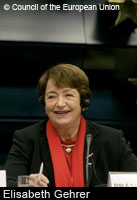
A 'large degree of consensus' was reached on those specific programmes proposed for the Seventh Framework Programme for research (FP7) that were discussed at the Competitiveness Council on 13 March, according to the Council conclusions. Following compromise proposals from the Commission, a debate took place on the following aspects of FP7: the Cooperation programme (collaborative research); the Ideas programme (establishment of a European Research Council); two programmes for actions to be carried out by the Joint Research Centre (JRC); and the Euratom programme for nuclear research and training activities. The debate focused on three issues: the ethical principles that apply to projects in respect to eligibility for funding under FP7; the broad principles governing the management and implementation of the specific programmes; and the implementation of the European Research Council (ERC). The other specific programmes proposed by the Commission have been or will be discussed at other Competitiveness Councils. Ministers also discussed the rules for participation for FP7, and listened to presentations on the setting up of a European Institute of Technology by the European Commission, and the report 'Creating an innovative Europe' by expert group chair Esko Aho. Speaking before the meeting, Council President and Austrian Minister for Education, Science and Culture Elisabeth Gehrer said that she was confident of an agreement on the content of FP7. She also emphasised the tight timeframe that the EU must keep to if FP7 is to begin on time. 'The punctual start of the programme on 1 January 2007 is the main priority for the coming months,' said the minister. 'In order to enable a smooth transition to the new framework programme, all decisions must be taken by the end of 2006.' The proposed Competitiveness and Innovation Framework Programme (CIP) was also the focus of discussion by ministers. The Council reached agreement on a partial general approach on the proposed programme, meaning that they determined non-budgetary elements of the proposal. Budgetary aspects cannot be finalised until there is an inter-institutional agreement on the financial perspectives for the period 2007 to 2013. The Council conclusions outline the following three points as the main features of the ministers' agreement: - clear articulation of the complementarities between CIP, FP7 and the Structural Funds; - clarification and higher visibility in respect to eco-innovation; - improvement of the monitoring and evaluation aspects of implementation of the CIP. CIP regroups three existing programmes - the entrepreneurship and innovation programme, the information and communications technology support programme, and the intelligent energy-Europe programme. It is intended to contribute to the enhancement of competitiveness and innovation capacity in the EU with a particular focus on small and medium sized enterprises (SMEs).