


World's largest carbon dioxide capture project opens in Denmark
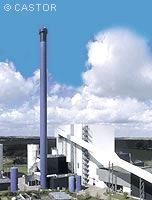
The CASTOR project, the world's largest carbon dioxide capture scheme and created with funding from the EU's Sixth Framework Programme (FP6), was inaugurated on 15 March at the Elsam coal-fired power station near Esbjerg, Denmark. The project is a large-scale trial to investigate how power station exhausts could be modified to remove the greenhouse gas carbon dioxide. The project, which includes 30 industrial, research and university partners from 11 European countries, is intended to achieve a working model that could cut carbon dioxide emissions by 10 per cent, which would represent 30 per cent of the total emissions from EU power stations. The EU needs to reduce its carbon dioxide emissions drastically if it is to meet targets first set under the Kyoto agreement, and then tightened under the Lisbon agreement. The Lisbon targets pose a 30 to 50 per cent reduction from 1990's baseline carbon dioxide emissions for 2020, and a 60 to 80 per cent reduction in emissions for 2050. European Science and Research Commissioner Janez Potocnik said: 'The European Commission is committed to a low-carbon future. The research policy of today is the energy policy of tomorrow, which is why projects like CASTOR have such an important contribution to make. By developing technologies for carbon capture and storage, we can reduce emissions in the medium-term as we move to large scale use of renewable, carbon-free energy sources.' The CASTOR system is not quite as straightforward as simply diverting the exhaust gases into a bag. The carbon capture technology relies on a solvent to dissolve carbon dioxide from the exhaust gases, which incorporates the carbon dioxide into a calcium cycle, yielding calcium carbonate (limestone). The remaining gases are then passed over a special solid to adsorb the remaining carbon dioxide. The carbon dioxide is then released either as limestone or carbon dioxide gas for geological storage. Last year European Energy Commissioner Andris Piebalgs placed energy efficiency and carbon capture at the top of his agenda for the Seventh Framework Programme for research. 'I personally have no doubt that in addition to increased use of renewable energy, fossil fuels will continue to be the backbone of global energy production for the foreseeable future. Given our commitment to Kyoto, now and in the future, the development of commercially viable technologies for CO2 capture and storage must be a Community goal,' he said in a speech to the European CO2 Capture and Storage Conference in April 2005. Some 85 per cent of Europe's energy needs are currently supplied by fossil fuels, and these are the primary sources of carbon dioxide. Other forms of energy are either too inefficient or not sufficiently advanced to supply the bulk of our needs, although Sweden recently announced its intention to eliminate fossil fuels from its economy. The next generation of fossil fuel-based power stations will use special 'cracking' systems to release the carbon from the fuel, leaving hydrogen and solid carbon. The hydrogen can then be burnt, as it is one of the few genuinely emissionless fuels, releasing only water as a by-product. The European Commission hopes that schemes such as CASTOR, in tandem with hydrogen fuel schemes and advances in renewable sources, will be a major contributor to reducing levels of carbon dioxide emissions. The goal is to achieve 'near zero emission power plant technology', and the EU recently signed a Memorandum of Understanding with the Chinese government to look more closely at achieving this.
Countries
Denmark