


Less talk, more action, urge Friends of Europe
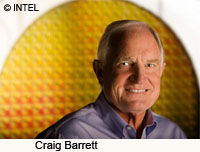
'25 years ago we worried about the technology gap - that the US was so far ahead of us. We are all still worried, and we are still wondering if we will ever catch up. I have seen an awful lot of talk, but the gap continues to widen,' said Giles Merritt, Secretary general of Friends of Europe, introducing the crossfire lunch debate on 28 March, summing up the views of many concerned about the state of European growth. Guest speakers were Craig Barrett, chairman of semiconductor behemoth Intel, which last year earned USD 39 billion, and MEP Vittorio Prodi, substitute on the Parliament's Committee on Industry, Research and Energy, and brother of former Commission President Romano Prodi. They addressed the theme 'Tackling Europe's Innovation Shortcomings', and gave responses perhaps appropriate to their respective continents - Mr Prodi's European government standpoint, and Mr Barrett's US-style focus on entrepreneurship. Both speakers come from academic backgrounds - Vittorio Prodi, in common with many of his siblings, is an active academic, a professor of physics at Bologna University. He began by referring the audience to the Commission's Framework Programme. 'FP7 is a design - a good design - for what the EU should do with basic understanding of research and development. It has to be [implemented] at an EU-level - Member States cannot give the answer any more. The Framework Programme is a good way to foster individual research and to maintain productivity and manufacturing in the EU. 'But,' he continued, 'there is incoherence under FP7. Resources are not up to the task for fostering strong research - for basic research, technology platforms and strategic technology initiatives. This worries me - we agree that this is a very important item. When action is needed, we let it get away. FP7 is good enough to indicate the way to go, but action is lacking. These financial activities are not enough. We need to give young researchers a future and attract more people to technology and universities, and keep them. We are not consistent here. Intel's Craig Barrett agreed that research and development (R&D) are essential, giving an example from Intel: 'This year, we put 15 per cent of our revenue back into R&D, which makes USD 6 billion in R&D. Since 1968, R&D spend has been constantly increasing at Intel, even in the post-bubble economy when every journalist told us this was wrong. You can never save out of a recession - you have to invest,' he said. To achieve this investment, Professor Prodi was asked if he expected a stand-off over FP7 funding. 'I'm prepared for it,' he replied. 'The message to the Council should be clear. The budget is not coherent to needs at an industrial level, and in bridging the gap between innovation and resources. [...FP7 is] indicated but not recognised by the financial perspective.' Mr Barrett outlined his recipe for developing growth, which relies much more on entrepreneurship and the infrastructure for taking companies to market rather than simply money for research. 'There are three things important for competition and innovation - product and research oriented R&D, an environment for investing in R&D, and education,' he said. He also provided another list, this one on successfully taking ideas to market. 'Firstly, strong university competition to attract money and researchers and the desire to be wealth creation machines through education spin-offs.' He cited Google as a highly successful spin-off from Stanford that yielded 'only a few hundred million dollars', for Stanford. 'Secondly,' he continued, 'you need business involvement to provide researchers and mentors. Lastly, you need ready availability of venture capital, from angel investors to provide set-up and business plan finance, venture capitalists to invest in the company, and an active venture to market.' He added that classes in entrepreneurship should be taught at university level. Such capital is conspicuously absent in the EU compared to the US, and spin-offs from EU universities have been far less successful in generating viable companies from research than their US counterparts. Start-up funding in the EU is on average one-sixth of the start-up funding for new US companies. Professor Prodi was asked about the 'rush to the bottom', a phrase much touted in the debate over the recent services directive, which refers to a fully integrated EU in which companies would move manufacturing to those countries with the lowest costs and standards. 'My fear is that there is a race to the bottom, and not a rush to the top. We need to persuade Member States that the reaching of excellence should be at an EU-level.' One possible method for achieving EU-wide excellence is the proposed European Institute for Technology (EIT). Moderator Pat Cox, former President of the European Parliament, asked for a show of hands from the audience to indicate whether they were in favour of such a body. A clear majority indicated that they were not in favour of an EU Technical Institute. Mr Cox then asked whether, if such a body did indeed become a reality regardless, the audience would favour a 'real' institute on a campus or a virtual one. A clear majority indicated that a virtual institute would be preferable. To bring the session to a close, Mr Barrett was asked whether the EU is more or less attractive to business today. Noting that Intel has already invested heavily in Ireland - would it invest in another EU Member State? The answer was instructive: 'We invested in Ireland because of blackmail and taxes. Blackmail due to the proposed 'local content' directive EC92, which incidentally did not pass, meant we had to hedge our bets. Ireland was chosen because of the very low tax base of 12 per cent and a high knowledge base. We have other centres in the EU, which are not tremendously large, but growing. Would Intel invest in other EU countries? No - simply because of the tax structure. In Eastern Europe? Maybe. Taxes there are much lower.' Could simply lowering taxes be enough to attract investment and bring us closer to the target of three per cent of GDP invested in R&D? New R&D expenditure targets for 2010 were published following the spring European Council. Targets for 2010 now stand at 1.5 per cent for Greece, 1.8 per cent for Portugal, two per cent for Spain and 2.5 per cent for Italy. Ireland and the UK have a 2.5 per cent target for 2014, while Finland and Sweden already invest three per cent or more in R&D. The rest of the EU15 countries still have the three per cent target intact. Meanwhile, in the US, President George W Bush's recent American Competitiveness Initiative is likely to keep any gap between the EU and the US economies intact.
Countries
United States