


Driving towards vehicle safety
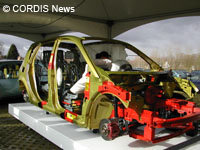
ULTIMATE, a joint Dutch, French and UK project funded by EUREKA has developed a sophisticated driving simulator that the developers hope will cut the costs of increased road safety. Driving simulators have traditionally been both expensive to build and operate, and unrealistic to use. The ULTIMATE project has developed a lightweight, accurate system for testing modifications to car design and how these modifications will influence safety. The main problem for vehicle simulators has been movement. Motor vehicles are highly manoeuvrable and able to accelerate quickly, for example in turning or braking. To replicate this movement in a controlled environment has been extremely challenging without the use of heavy, expensive equipment to replicate the sensations of movement. The ULTIMATE project achieved a low-cost, lightweight design. The 3.5-ton platform and visual array give a realistic experience to the user, and therefore valuable results for the researcher. The interior of the simulator is modular, enabling researchers to chop and change the interior to see how these changes influence safety. The simulator may be used in the earliest stages of vehicle design in order to maximise driver safety. 'We needed to overcome the mechanical constraints of earlier simulators to be able to accelerate for a sufficient duration of one to three seconds at 0.1g for example in X and Y axes with a high payload,' said project director Dr Andras Kemeny, head of Renault's technical centre for simulation. This gives the simulator movement of up to seven metres per second in forward and back, and left and right directions, which adequately simulates movement. The moving platform was developed by Dutch partner Rexroth-Hydraudyne. The simulator's visual array was developed by partner group SEOS, which produced a screen, curved by 150 degrees, to give a realistic appearance of motion. If there is simply not enough room for the screen, then the driver may wear a head-mounted display to give a virtual cockpit. SEOS initially contacted Renault about simulation. 'We became involved as an original partner pulled out. We asked for modifications and encouraged other partners to join. A second EUREKA project - MOVES - will extend the work for ULTIMATE to optimise the software and the motion algorithms,' said Dr Kemeny. The new project will be led by the French National Centre for Scientific Research (CNRS). The project has built up 15 databases representing different types of journey. Each tests a different variable, such as different driving aids, intelligent steering, or seeing how drivers react when stressed or distracted. A similar device is available in the US for academic research, but costs USD 66 million (53.8 million euro). ULTIMATE achieves something comparable for 2.58 million euro, achieving road safety at low cost.
Countries
France, Netherlands, United Kingdom