


Europe's space laboratory ready for launch
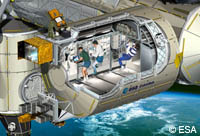
The Columbus laboratory, Europe's single most important contribution to the International Space Station (ISS), has been successfully completed. It is now ready to be shipped to Cape Canaveral in the US at the end of May, from where it is scheduled to be flown to the ISS in the second half of 2007. The laboratory, a one billion euro project of the European Space Agency, will provide European researchers the chance to conduct a vast programme of experiments in the areas of life and physical sciences, materials science, fundamental physics and technology research over a ten-year period. Speaking on 2 May at the inaugural ceremony, held at the Bremen-based European Aeronautic Defence and Space Company (EADS SPACE) where the laboratory was built, ESA Director General Jean-Jacques Dordain highlighted the pan-European nature of the project, which saw 40 companies from ten EU countries coming together: 'There are many companies who were involved. They have all done an excellent job and I would like to thank them for that today.' Also attending the ceremony, Chancellor Angela Merkel, underlined Germany's contribution to the European project: 'It is a small, but important sector where a country like Germany, which is known as a land of high technology and leading science, stands up very, very well.' The laboratory, which took ten years to build, is a cylinder of aluminium alloy, 4.5 metres wide and 6.7 metres long. Inside, the pressurised module has room for ten International Standard Payload Racks (ISPRs), eight situated in the sidewalls, and two in the ceiling area. Each rack is the size of a telephone booth and is able to host its own autonomous and independent laboratory, complete with power and cooling systems, as well as video and data links back to researchers on Earth. These racks, the ESA says, are tailored to 'squeeze the maximum amount of research from the minimum of space and to offer European scientists across a wide range of disciplines full access to a weightless environment that cannot possibly be duplicated on Earth'. Racks include the European Physiology Modules Facility (EPM), in which sets of experiments will be used to investigate the effects of long-duration spaceflight on the human body, such as age-related bone loss, balance disorders and other ailments. The Material Science Laboratory Electromagnetic Levitator (MSL-EML) will help researchers investigate the melting and solidification of conductive metals, alloys or semi-conductors. A Fluid Science Laboratory (FSL) will accommodate experiments in weightless liquids. According to ESA, these facilities could help improve life on Earth by finding better ways to clean up oil spills, or even improving manufacture of optical lenses. Outside the pressurized hull, Columbus has four mounting points for external payloads, which ESA say will provide an 'unhindered' view of the Earth and outer space, and allow for a host of other experiments, ranging from how bacteria can survive on an artificial meteorite to volcanic activity 400 km below on the Earth.