


Cutting-edge IST projects showcased at Asian fair
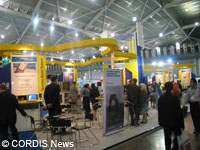
Some of Europe's most innovative and promising information and communications technology (ICT) projects were on display in Singapore during the week of 20 to 23 June, at a fair attracting around 47,000 visitors. The EU projects on display showcased European capabilities in the e-health, e-government, audiovisual, e-security and telecommunications fields. This was the first year in which the European ICT Pavilion appeared at CommunicAsia, one of 15 ICT conferences taking place within the same week in Singapore. One of the projects receiving a great deal of attention was MYHEART. With a budget of EUR 35 million, MYHEART is one of the biggest projects under the information society technologies (IST) section of the EU's Sixth Framework Programme (FP6). CORDIS News spoke to the project coordinator, Jörg Habetha of Philips Research Laboratories, who explained that the overall approach of MYHEART is to monitor vital signs through on-body sensors, most of which will be incorporated in to textiles. The team of 33 partners is also developing systems to be integrated into clothing that can send information to either a patient's or a care provider's telephone. The alerts are not limited to warning that a patient's condition is critical, but also send advice if a patient needs to be careful. 'We are not only measuring, we want to influence the behaviour of patients as well,' said Dr Habetha. The project started at the end of 2003, and the partners have spent much time assessing the various approaches open to them and selecting four to pursue. 'This is unique,' said Dr Habetha. 'In the middle of the project we discarded things that weren't interesting enough.' The four concepts selected were: heart failure management; stroke rehabilitation; health coaching and activity coaching. User studies will commence in November. The BRICKS project is developing soft infrastructure for digital libraries. The project is also building a BRICKS community, comprising content providers, art professionals, art researchers, students, tourists and citizens in order to build a consensus and share knowledge and services related to digital content. Project participant Fiore Basile explained that attending the CommunicAsia fair was an excellent opportunity to raise awareness of the BRICKS community in South East Asia, membership of which is open to all and free of charge. A Thai organisation is already involved. The BRICKS architecture will be decentralised, based on a peer-to-peer paradigm and open source software. The aim is to give an overview of digital cultural heritage, and a priority is providing this overview to smaller players. 'We have the possibility to give small libraries and institutes access to the state of the art, which is free to use,' said Dr Basile. The use of metadata will also enable users to search for content in any language. BRICKS will also represent the first digital rights open source platform. As Dr Basile explained, digital rights are a means to acquire revenue for digital content, which is otherwise quite difficult. Also on display in the European Pavilion was the TERREGOV project, which sees 16 partners working towards enabling local governments to deliver online services to citizens in a straightforward manner. The research is focused on technical interoperability, semantic interoperability and organisational operability, while socio-economics researchers are assessing how the organisational changes needed for the move to e-government can be implemented efficiently. Local governments in four countries -France, Italy, Poland and the UK - are participating in pilot activities. In the UK the pilot is linked to the Supporting People initiative, a public programme offering guidance and support for vulnerable people. The TERREGOV scheme focuses on supporting the business processes that underlie the management and delivery of care services by local governments. It involves local governments, central government and social care providers, thus improving inter-agency collaboration. It should allow more citizens to receive services by reducing administrative costs. An important part of the project is the use of semantic technologies, project participant María Pérez Ortega told CORDIS News. 'Using semantics gives meaning to the data,' she explained. For example, the system will know not to differentiate between the words 'client' and 'customer' in English, which have, in most contexts, the same meaning. The POF-ALL projects was on display in Singapore in order to 'show Asia what we're doing as an alternative to their approach to the Internet', according to Alessandro Nocivelli from Italian company Luceat. 'POF' stands for plastic optical fibre, and the POF-ALL partners believe that it will enable telecoms operators to provide 100Mbps Internet access to home networks. Operators are currently facing high costs and installation challenges that are restricting the deployment of optical fibre. The visitors to the POF-ALL stand had been very interested in the technology, according to Mr Nocivelli. 'They didn't know [the technology], and we can be very proud that Europe is at the forefront of this technology. [...] At least for once we can teach something to Asia and America,' he added. Also present within the European Pavilion was PIONIER, the Polish research and education network, which links over 700 research and academic institutions in Poland. PIONIER is connected to GÉANT2, Europe's multi-gigabit network. Two of the projects using PIONEER were being showcased in Singapore: iTVP and VLAB. The iTVP Platform is allowing the Internet Protocol (IP) based delivery of interactive TV services through the PIONIER network. Users receive high quality multimedia services, near video on demand and value added services. The technology also allows for time shifting, meaning that a user can shift back in time if he or she missed the beginning of a live transmission. The technology was used to broadcast last winter's Olympic Games, and served over 850,000 streams. It also allows Poles outside of Poland to listen to Polish radio. The Virtual Laboratory (VLAB) project is also supported by PIONIER. The project's primary goal is to prepare the infrastructure enabling the sharing of scientific instruments using the Internet. This will allow scientists to prepare for experiments remotely, rather than having to travel to the location of an apparatus and staying there until the results are available. All the scientist needs is an Internet connection. 'This means that very expensive instruments can be shared,' Dominik Stoklosa from the Poznan Supercomputing and Networking Centre told CORDIS News. Telescopes have been the focus of the project thus far, but the technology is being extended to spectrometers and a freeze atmospheric dryer. VLAB will also contribute to the EU-funded RingGrid project. For the European scientists that CORDIS News spoke to, the main reason for attending the Asian fair was to find out what is going on in a different part of the world. Scientists were also hoping to identify potential partners for research and to raise awareness of the work being done within Europe.
Countries
Singapore