


Can the Descartes Prize reward both hard and soft sciences?
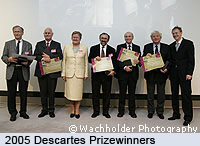
Since its inception in 2000, the Descartes Prize has attracted more and more attention, both from would-be winners and the media. The rise of the prize has been accompanied by questions on its set-up and rules, a jury is yet to come up with a definitive answer to the hard science versus basic science dilemma - can and should the prize cover both? The Descartes Prize has gone to scientists from diverse disciplines in the past, and in 2005 was rewarded to a social sciences team for the first time for its European Social Survey. But the doubt remains: can projects from the social sciences really be evaluated alongside, and therefore compared to, projects from the hard sciences? Dr Ion Siotis, President of Greece's National Centre for Scientific Research, Demokritos, was invited to give a presentation on this issue at a dinner debate for the 2006 Descartes Grand Jury and others on 10 July. Dr Siotis provoked his audience by suggesting that there is a dichotomy between 'science' on the one hand and 'humanities' on the other. He posed a number of questions: is the divide deeper today than it has been in the past? Does it matter? Should research in history, archaeology, psychology, linguistics be absent from the Descartes Prize thematic categories? If so, should socio-economic research be present? Should the Grand Jury comprise randomly selected non-scientists? Dr Edward Van den Heuvel was joint winner in 2002 for his research on gamma ray bursts. He was present on 10 July, and suggested that while a prize for the humanities alongside a prize for the hard sciences would be a good idea, the two disciplines are not so dissimilar. 'An important part of all sciences is critical thinking. Asking the question 'is this really true?' holds for social science as well as the natural sciences. [...] The different disciplines may on the surface appear to be different, but if you start with critical thinking, they seem all to be connected,' said Dr Van den Heuvel. Other participants agreed, adding that young people should not be forced to choose between the hard and soft sciences, but should be encouraged to practise critical thinking. The 2006 Grand Jury is chaired by Claudie Haigneré, French Minister for Research and New Technologies from 2002 to 2004 and former astronaut. While the jury this year has more women than men, she drew attention to the absence of women project coordinators from the Descartes nominees. 'This is something we will have to think about,' she said. Others were divided on this point, with some arguing for no such criteria in order to ensure that excellence is rewarded, and others saying that as the Descartes Prize is an EU prize, criteria should reflect the EU's policies and priorities. The winners will be announced at a prize ceremony coinciding with the launch event for the Seventh Framework Programme (FP7) in March 2007 in Germany.