


EU project receives meteorology award for multi-model prediction system
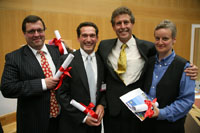
An EU-funded project has been recognised by the World Meteorological Organization for a paper on the project, entitled 'Development of a European Multi-model Ensemble System for Seasonal-to-Interannual Prediction' (DEMETER). The NORBERT Gerbier Mumm award recognises an original scientific paper on the influence of meteorology in a particular field of the physical, natural or human sciences, or on the influence of one of these sciences on meteorology. DEMETER was funded under the EU's Fifth Framework Programme (FP5), under the 'Energy, environment and sustainable development' sub-section. It involved 12 partners - 11 from Europe and one from the US. Prior to DEMETER, there were seven quasi-independent state-of-the-art global coupled atmosphere-ocean models, developed at different institutes in Europe. The project involved the installation of all seven models on a common super computer. The use of a multi-model ensemble system allows for uncertainties in model formulation to be included in the estimation of seasonal forecast probabilities. Creating a multi-model system broke new ground, as other institutes around the world are not yet in a position to implement such a system. The results of the project will be visible for many years to come - an extensive set of six-monthly hindcast datasets are generated four times per year, and will be run for around 40 years. Data has also been linked to tropical disease prediction models and European crop yield models. DEMETER built upon the FP4 project PROVOST, which focused on the predictability of seasonal and interannual atmospheric variability. It has been succeeded in FP6 by EUROSIP (European Seasonal to Inter-annual Predictions), creating a multimodel system The project was coordinated by the European Centre for Medium range Weather Forecasting (ECMWF). According to Head of Research at ECMWF Philippe Bougeault, 'The results of this multidisciplinary investigation not only confirm the promising developments carried out in dynamical seasonal ensemble forecasting, but also demonstrate the value of climate forecasts, giving the scientists the motivation to explore new avenues for realising the full potential of our forecasts for real and end-user application.' Accepting the award, Dr Tim Palmer, also from the ECMWF, announced that the prize money would be used to train African scientists to make use of the ensemble climate prediction products. Dr Palmer closed his remarks with a personal reflection on the future of climate modelling and predictions, stating that: 'Our current approach limits what we can deliver to policy- and decision-makers.' He urged nations to pool their resources to create major computing facilities that can run ensembles of models at a high enough resolution to be capable of providing meaningful climate information at the regional and local scales.