


Shaping the future of Europe's international research cooperation
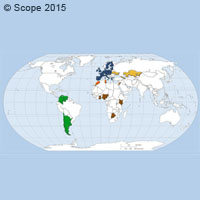
As preparations get underway for the launch of the Seventh Framework Programme (FP7), work has already begun that is looking to FP8 and to what research policy might look like by 2015. An EU-funded project has outlined a vision of how the EU's international cooperation in science and technology might develop in the future. It sees the EU focusing on, among other things, helping developing countries to reform their research policy rather than investing directly in research. For more than 20 years, the EU has been supporting international cooperation in research with countries all over the world. This promotes sustainable development, and research and development (R&D) partnerships. This cooperation has been implemented by the EU's International Science and Technology Cooperation programme (INCO). In preparation for FP7 and FP8, the European Commission has been looking at how this cooperation can be extended. With this goal in mind, the European Commission's Research Directorate General commissioned the Scope 2015 project to look at how research in developing countries might evolve in the next ten years. This could then inform how EU international cooperation policy should be developed. Dr Michael Keenan is from the Policy Research on Engineering Science and Technology (PREST) at the UK's University of Manchester. Dr Keenan led the project and explained to CORDIS News what they set out to achieve. 'We were interested at looking at the threats that these counties faced as well as how European research could address some of them in collaboration with researchers locally. 'We were also looking at ways in which Europe or even Member States could aid reform of science policy and research infrastructures of these countries. Many of them are saddled with institutes that embody an old kind of model of science: laboratories that have been implanted there in the 1960s and 1970s which haven't been updated to take into account a contemporary understanding around innovation processes.' According to Dr Patrick Crehan, from Belgium-based CKA, another of the project partners, the foresight exercise came from a belief that increasing international science cooperation could have much greater impact. 'The creation of knowledge is an essential part of the creation of prosperity and our security in the world depends upon helping our neighbours to prosper and develop interests that are intertwined with our own. It sounds like the basic philosophy for the establishment the EU which is now being projected on a global level. The pioneer in a sense is science cooperation and the link with development,' Dr Crehan told CORDIS News. The project began by studying trends and drivers of research and research infrastructures in individual countries in four world regions: Commonwealth of Independent States (CIS, excluding Russia), Latin America (excluding Brazil), Maghreb and Mashreq, and Sub-Saharan Africa (excluding South Africa). Initially, the researchers predicted that problems in the four regions would be very different, making conclusions difficult to tie together. However, while there were a number of specific regional issues, the research found that the four regions were facing many of the same problems. These included a chronic under-investment in research, technology and development (RTD), brain drain, research institutes and governance in need of reform; little private research; minimal capacities for new technologies; and inability to use research to solve problems of sustainability. The data also revealed a high level of enthusiasm for collaboration with EU scientists, but not enough awareness of opportunities; and interest in increasing links between countries in the same region. The team developed three 10-year scenarios for each region, modelling bad, worse, and best-case scenarios. 'The first scenario showed what would happen if things didn't change, the second was even more negative because we got feedback from national and regional experts that the situation could get a lot worse. The last one was more visionary, presenting a different paradigm,' Dr Keenan explained. These scenarios were then handed to workshops of national and regional policy makers and scientists, to consider what Europe could do to help tackle the challenges outlined in each of the scenarios. From this, the team was able to draft action points for each region as well as a set of generic recommendations for the possible action by the European Commission. Although the project initially set out to provide recommendations for research priority areas where EU research cooperation should focus its support, it became clear that this was impossible given the scope of the project. Instead it focused on the EU cooperation efforts which would strengthen the research infrastructures of the region. 'Our recommendations make the case that the most valuable cooperation in the end is for the EU to help policymakers formulate policies and use its resources to help these regions talk to the people they need to talk to make this happen. Once this happens, industry and other actors will get behind it and research will flow,' explained Dr Crehan. The recommendations propose, among other things, transferring the European Research Area (ERA) concept to regions like Latin America where policy makers showed a great deal of interest in it, and expanding the ERA to include non-EU Member States. The project also recommends that EU resources should go towards helping policy makers develop skills for policy design and management. Linked to this is the need to crank-up surveillance and monitoring, to generate better information needed for better policy interventions. The team suggest that EU information gathering projects such as the trend chart and R&D scoreboard as well as ERA-Watch could be extended to other parts of the world. Although the Scope2015 is now complete, the project partners say the INCO programme is currently looking at the recommendations and how they can be incorporated into its future work. The project's foresight techniques have also been taken up by other projects in the INCO programme and the Euro-Mediterranean Partnership (MEDA) programme. The project partners will make a final draft of its report in the coming months.