


Salamander robot provides clues to evolution of first vertebrates
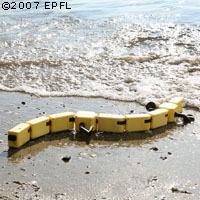
French and Swiss researchers have designed a robot that they say is providing crucial insight into the evolution of vertebrates from water to land. The researchers based the design of their robot on salamanders. These are the perfect animals to teach us more about the evolution from aquatic to terrestrial habitats, since they are able to switch from swimming to walking. Given that salamanders also have fewer neurons than mammals, they are also easier to model. Furthermore, their central nervous system shares many similarities with that of a lamprey, an extensively studied primitive fish. The 85 cm yellow robot, which has been tested in Lake Geneva, is composed of 10 motors that drive a body of four rotating legs and joints. Using a remote-control system, the researchers send electrical signals - similar to those that the upper brain sends to the spinal cord - to the robot. Depending on the intensity of the signals, the robot is able increase its speed or move from swimming to crawling or walking. The researchers suggest that this demonstrates how gait transition between swimming and walking can be obtained by simply varying the level of stimulation of the brain stem. The researchers believe that the robot will not only answer some questions about the emergence from water of the first vertebrates, but it will also provide insight into how movement is controlled by neural mechanisms located in the spinal cord. 'Nature found a nice way of making a sophisticated circuit in the spinal cord and then controlling the muscles from there,' said Auke Ijspeert of the Swiss federal polytechnical school in Lausanne, and one of the researchers in the project. 'It's a fantastic solution for coordinating multiple degrees of freedom in a simple, distributed way.'
Countries
Switzerland, France