


Did the earth move?
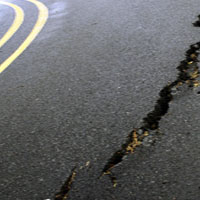
A French-Belgian partnership under the umbrella of a EUREKA project has developed an innovative product for detecting early signs of soil subsidence in critical areas where railway tracks are to be built. Existing monitoring systems for earth subsidence rely on visual inspection, an inefficient method of assessing the crucial subsidence for railways, where more than a 2 millimetre change in track level can have disastrous results. The GEODETECT project has developed a grid of fibre-optic sensors which it has embedded in to a composite material of non-woven, fibrous matting called 'geotextile', to make a layer which can be built into structures where reinforcement is essential for long term stability. The sensory fibres offer continuous monitoring and an early warning system of earth movement. The coordinator of the project, Dr Alain Nancey, explains: 'Adding sensors linked by optical fibres into the geotextile enables hundreds of them to be installed quickly into the ground, in a critical area where there is risk of collapse.' 'If a cavity appears in the soil under the geotextile, the resulting lengthening of the fibre in the matting will be detected by the sensors and be relayed to the monitoring system. In the case of a railway, for example, the affected track section can then be isolated and repaired quickly before real damage is done,' he continues. GEODETECT has already received interest from the French national railway company SNCF, and the future looks even more promising with the prospect of the trans-European rail network, which the EU is seeking to build to carry high-speed trains running at speeds of over 250 km/h. EUREKA is a pan-European, intergovernmental initiative that has been supporting industrial, market-oriented research since 1985. The European Union is a member of EUREKA, along with 37 European countries.
Countries
Belgium, France