


World's strongest magnet attracts researchers to Berlin
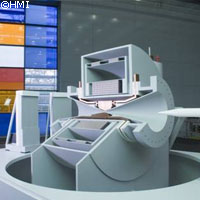
Plans are underway to build the world's strongest magnet for neutron scattering experiments at the Hahn-Meitner-Institute (HMI) in Berlin, Germany. When completed in 2010, the €6.4 million magnet, which is to be funded primarily by the German Federal Ministry for Education and Research (BMBF), is expected to produce a magnetic field of between 25 tesla and 30 tesla - more than half a million times stronger than the Earth's magnetic field. This will eclipse the 15-tesla system currently running at the HMI. In addition to the €6.4 million for building the magnet, a further €10.6 million will be invested in the magnet's infrastructure, such as cooling and current supplies. 'With this major piece of equipment, Hahn-Meitner Institute itself becomes a magnet, pulling in researchers from around the world to Berlin,' said Thomas Rachel, Parliamentary State Secretary for Education and Research. To attain this unprecedented magnetic power, the system design will comprise a copper-coil inside a superconducting magnet, cooled with liquid helium. The copper-coil insert will be powered by an electrical current, while the near-absolute zero temperature superconducting exterior will conduct electricity without resistance. By combining the power supplies of these technologies, engineers can produce extremely high magnetic fields using just one-third of the power required by traditional magnets. The conical and horizontal design of the magnet will make it ideal for neutron scattering experiments, since it will be able to scatter neutrons at much larger angles than traditional high-field magnets. Neutron scattering is considered one of the best ways to probe atoms in order to better understand the structure of materials. With the new magnet, researchers expect experiments to yield new insight in physics, chemistry, biology, and materials science. For example, experiments are expected to contribute to developing a comprehensive theory on high-temperature superconductors - the ability of individual substances to conduct electric current without resistance at higher temperatures. The magnet will be built by the National High Magnetic Field Laboratory and Florida State University in the US.
Countries
Germany