


Researchers discover gene that protects against kidney disease
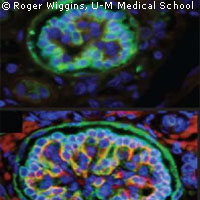
Researchers from the European Molecular Biology Laboratory (EMBL) and the US have discovered a gene that protects humans against a serious kidney disease. Writing in the online July issue of Nature Genetics, the scientists report their findings that mutations in the gene cause nephronopthisis (NPHP) in both humans and mice. The kidneys help the body to filter and dispose of potentially harmful waste. Although diseases that affect this fundamental function are very serious, so far they are still poorly understood. NPHP is one such disease. It causes kidneys to degenerate and shrink at a very early stage in childhood, often leading to renal failure before the age of 30. So far, kidney transplantation in early age has been the only way to save patients suffering from NPHP. With a new mouse model, Mathias Treier and his group at the EMBL have shed new light on the molecular mechanisms underlying NPHP, opening up novel ways to treat the disease through non-invasive therapies. 'Our mice show striking similarities with NPHP patients,' says Mathias Treier, the leader of the group at the EMBL. 'Very early on in their lives their kidney cells start to die and the mice develop all the characteristic disease symptoms. It is the first time that a mouse model reveals increased cell death as the mechanism underpinning kidney degeneration in NPHP. The genetic cause is a mutation in a gene called GLIS2.' GLIS2 normally prevents cell death in the adult kidney. It carries out this work by shutting down genes that initiate cell death and that are only required during the development of the organ. A mutation interfering with the GLIS2 function reactivates these harmful genes, with the ensuing result that large numbers of kidney cells die. The organ shrinks and changes in its architecture occur, which affect the normal kidney function. To find out if GLIS2 has the same effect in humans, the team of researchers carried out a genetic screening of patients suffering from NPHP. The team found that, like the mouse model, some patients carried mutations in the same GLIS2 gene, confirming that GLIS2 is a crucial player in NPHP in humans. 'This is an excellent example of how combining basic research with clinical studies can help uncovering mechanisms of human disease,' says Henriette Uhlenhaut, participated in the research in Dr Treier's lab. 'The next step will be to translate the insights gained into new therapeutic approaches to develop alternatives to kidney transplantations. With GLIS2 we have already identified one promising candidate drug target and our mouse model will help us find many others,' Mrs Uhlenhaut added.