


Climate change affecting glaciers at all altitudes, study shows
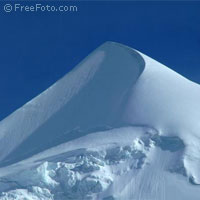
Even high altitude glaciers in the Alps are being affecting by climate change, according to two new studies by French and Swiss scientists. The first study investigated the massive Saint Sorlin glacier which lies at an altitude of 3,400 metres. Like all glaciers, the Saint Sorlin is maintained by snow falling on to its upper reaches and packing down to form ice. Meanwhile at the lower end of the glacier, warmer temperatures cause the ice to melt. The balance between the accumulation and loss of ice is affected by climatic conditions. The scientists calculated the changes in this balance for the years 1981 to 2004, and simulated its future evolution based on the B1 scenario of the Intergovernmental Panel for Climate Change (IPCC). This is one of the IPCC's more optimistic scenarios, and it predicts a temperature increase of just 1.8°C by 2100. Nevertheless, even with this relatively small temperature increase (compared to the other scenarios) the glacier is likely to have practically disappeared by 2060. The reason for this is that the lower limit for snow accumulation will be higher up the mountain than the highest point of the glacier. As the glacier will no longer accumulate snow in winter, it will steadily lose mass until it disappears completely. The scientists warn that many other small Alpine glaciers of a similar altitude could face a similar fate. The other study looked at the temperature changes inside the 4250 metre altitude Col du Dôme glacier in the Mont Blanc area. In 1994 and 2005 the researchers drilled boreholes at the same location in the ice to measure the temperature deep inside the glacier. They found that in the intervening years, the temperature increased by up to 1.5°C. While some of this temperature increase can be attributed to the warming of the atmosphere, some is due to the latent heat produced when meltwater on the surface of the glacier trickles down through the ice and refreezes at depth. The researchers warn that this could have serious consequences if the depths of the glaciers continue to warm up. 'Simulations for different climatic scenarios show that glaciated areas located between 3500 and 4250 metres could become temperate in the future,' the scientists write. 'This warming could have a major impact on the stability of hanging glaciers frozen to their beds if the melting point is reached.' The studies are published in the journals Earth and Planetary Science Letters and Geophysical Research Letters.
Countries
Switzerland, France