


On the ball! Spanish researchers devise new technique to better train assistant referees
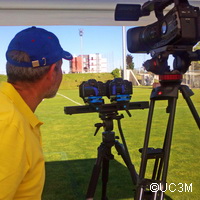
Spanish football fans the world over are still basking in their team's triumphant win over Italy in Sunday's Euro 2012 final. And now it seems there is also reason to celebrate the Mediterranean nation's sports research skills, as a team of Spanish researchers present a new teaching method for assistant referees based on stereoscopic technology. Researchers from the Universidad Carlos III de Madrid (UC3M) are applying stereoscopic three-dimensional (3D) technology to record exercises on the offside position in the hope that these can be used by the Fédération Internationale de Football Association (FIFA) as a teaching material in professional training courses for assistant referees. The aim of this innovative project is to improve how assistant referees learn their craft via the use of multimedia materials that offer a visual experience close to what referees on the pitch experience, and which can train visual perception in decision-making calls on offside plays. The researchers, who form the UC3M Television-Film group: memory, representation and industry (TECMERIN), spent two days recording 500 simulations of offside plays in stereoscopic 3D with different types of exercises, similar to those used in professional training courses for international FIFA referees. 'Among these, those most appropriate to create interactive material to be used by assistant referees all over the world will be chosen,' comments project coordinator Professor Manuel Armenteros. 'The use of stereoscopic images will significantly improve the learning experience due to the fact that a 3D stereoscopic image learning environment generates a visual experience that is much more realistic than 2D.' Stereoscopic images are made using two lenses, one for each eye, which obtain a greater sense of depth than 2D images. The visual perceptive systems use the differences between the images of each eye to calculate depth. The researchers note that although stereoscopic 3D technology has been around for years, it wasn't until the 'digital revolution' that this technology really took off. Thanks to the ability to digitally treat images, it is much simpler to overlap the two images necessary for the creation of stereoscopic images. Now, stereoscopic 3D technology is used in a wide variety of fields, including recording as well as visualisation devices. Professor Armenteros believes that for visual technologies these developments are as important an advancement as the onset of colour technology was. The hope is that the technique they develop will bring more accuracy to the football pitch and help assistant referees better make tricky judgements - something that remains important for the integrity of the beautiful game.For more information, please visit:Universidad Carlos III de Madrid (UC3M):http://www.uc3m.es/portal/page/portal/home
Countries
Spain