Manipulating time perception to improve well-being

Our perception of time is influenced by factors such as our environment and how we feel about the task that we might be currently undertaking. “People often say: ‘time flies when you’re having fun’, and this is sort of true,” says ChronoPilot(opens in new window) project coordinator Argiro Vatakis from Panteion University(opens in new window) in Greece. “The same five minutes can feel longer when we’re bored. This is due to the cognitive processes involved in time perception.”
Manipulating cognitive processes
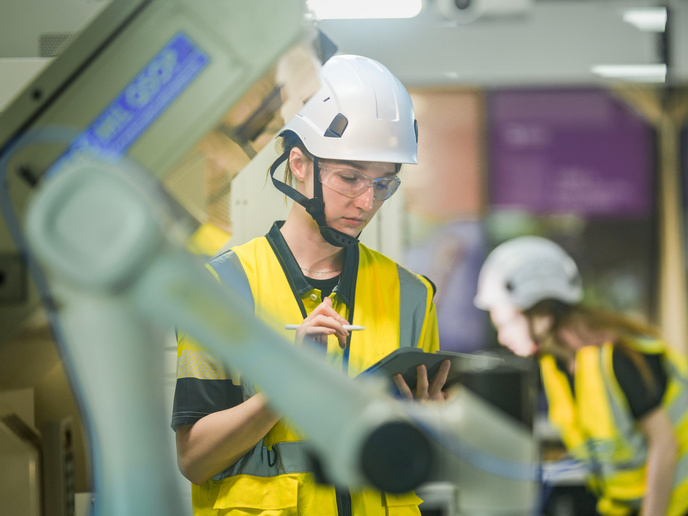
In other words, the processes that shape our experience of time – various brain networks and neurotransmitters – are malleable enough to alter our perception of time passing, even when five minutes is, of course, always just five minutes. The EU-funded ChronoPilot project sought to capitalise on this well-documented phenomenon, by seeing if cognitive processes could be intentionally manipulated to ‘speed up’ or ‘slow down’ time. The aim was to assess whether such techniques could be used to improve someone’s well-being and/or productivity. ChronoPilot focused on the workplace, where increasing automation is likely to involve a variety of human-robot interactions in the future. Volunteers were placed in two simulated scenarios – operating precision farming drones and working on an industrial production line – to test the team’s hypotheses.
Stimulating time perception
Tests began by measuring variables such as the heart rate of volunteers to establish a baseline, and to understand how people perform in a non-stressed, non-bored state. Once the task began – usually involving volunteers wearing virtual reality (VR) goggles or operating in an augmented reality (AR) room – physiological data was fed into an algorithm. This detected physiological changes, indicating if a person was understimulated or overstimulated. Time judgements were made by asking volunteers to estimate the duration of a particular activity. If volunteers deviated from their baseline, auditory, tactile and/or visual stimulation was applied, to compress or expand a person’s sense of time. “This might involve something like an object pulsating in the AR or VR environment,” explains Vatakis. “We then observed whether this helped to bring the person back to their baseline, or if further stimulation was needed.”
Overall well-being and mental health
In both scenarios, the team was able to show that stimulating neural networks could influence time perception and potentially benefit well-being and task performance. “Next steps include developing new ways of measuring the physiological state of users and increasing the ways in which we can modulate the perception of time,” adds Vatakis. “One thing we found was that time modulation only lasts for short periods, so this is something we’d like to look into further.” The project’s technological innovations, such as the VR/AR environments and decision-making algorithms, could also be further advanced. Vatakis believes that the concept could have many real-world applications down the line. “One example could be a hospital environment for long-term patients,” she says. “In such cases, creating stimulation that makes time pass ‘faster’ could be very beneficial to the overall well-being and mental health.” Other possible end uses include industrial settings that involve mundane tasks, or nightshift work where our body clocks are shifted. “This is first and foremost about keeping people in a good state away from the negative effects of stress or boredom,” remarks Vatakis.