How languages interact in bilinguals, and why it matters

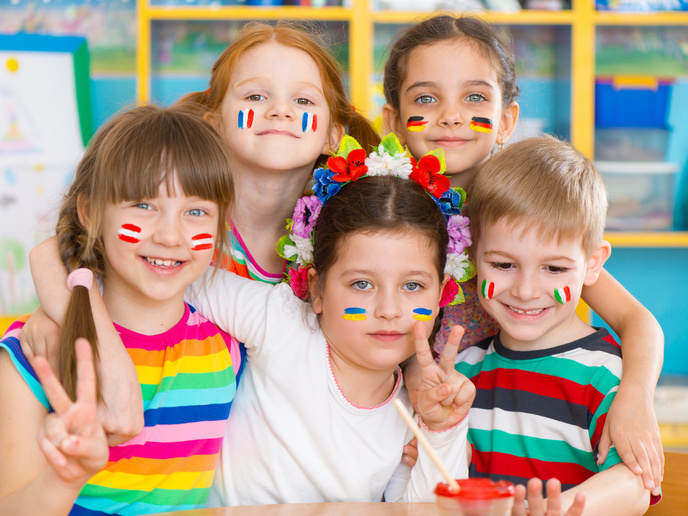
Migration within Europe has increased the number of multilingual students attending mainstream schools. For example, in Germany many primary schools have bilingual students with Greek as their first language. Conversely, in Greece bilingual children with German as their first language attend German or Greek schools. “Yet, despite the growing body of research on multilingualism, the question of how it develops – including the influence of individual factors – remains understudied,” says Spyridoula Varlokosta, coordinator of the FIHELaD project, which was funded by the Marie Skłodowska-Curie Actions(opens in new window) programme. Addressing this knowledge gap, FIHELaD combined experimental observations with eye-tracking data, to investigate language processing by Greek-German bilingual children. “We offer new evidence about how bilingual children organise and access linguistic knowledge, supporting the theory that this language faculty operates as a specialised cognitive subsystem,” adds Varlokosta.
Heritage languages as languages in their own right
FIHELaD focused on Greek and German speakers partly for practical reasons: a Greek project host, the National and Kapodistrian University of Athens(opens in new window), and German partners provided ready access to study participants. Additionally, the Greek community in Germany is among the largest in the EU(opens in new window), while the German bilingual community in Greece is significant. The project’s Athens base also enabled the study of children acquiring Greek as their majority language (and German as a minority language) for comparison. “Additionally, and crucially, Greek and German present useful grammatical contrasts linguistically for investigating how heritage (home) and majority (environment) languages are represented and processed in bilingual children,” notes Varlokosta. Methodologically, instead of viewing heritage languages as imperfect or unfinished versions of a ‘standard’ monolingual language, the team treated them as full linguistic systems in their own right. The project then set out to investigate: which grammatical properties systematically emerge in heritage grammars; how cross-linguistic influence from the majority language affects grammatical development in heritage languages; and how heritage grammars reach a stable state. “We didn’t want heritage languages to be judged against monolingual norms, but rather understood on their own terms, as shaped by the experience of bilinguals,” explains Varlokosta.
Empirical insights into bilingualism
The team developed a methodology to study heritage languages, involving offline tasks and online language processing measures. Twenty children in each country (Germany and Greece) took part in offline tasks involving questionnaires and traditional linguistic assessments designed to measure children’s comprehension of complex linguistic constructions. The online tasks used eye-tracking technology to capture real-time sentence processing, with children listening to complex sentences and then selecting which of two pictures matched what they heard. Recording real-time ‘gaze patterns’ afforded highly sensitive insights into how bilingual children parse grammatically complex sentences. “This is a significant advancement in heritage language research, as it contributes a refined set of tools adoptable or adaptable for future research on bilingualism, multilingualism and heritage languages,” notes Varlokosta.
Implications for more inclusive educational practices
Using inferential statistical methods, the team are currently analysing the data to identify which linguistic and non-linguistic (cognitive and social) factors best explain participants’ performance, in the offline and eye-tracking tasks. Preliminary findings reveal that Greek-German bilingual children display processing patterns divergent from both monolingual Greek-speaking children and from adult controls. “This indicates that bilingual children draw on different strategies when interpreting complex syntactic structures, illustrating the interaction of heritage and majority languages during language development,” says Varlokosta. As these findings have implications for more inclusive education which supports bilingual and heritage language learners, the team intend to develop an open access Moodle course focused on complex syntactic structures, designed for integration into existing EU educational toolboxes.