Helping first responders prepare for emergencies


Natural disasters do not respect national borders. Nor do they act alone. As a case in point, one need look no further than the devastating 2023 Turkish earthquakes. Not only did multiple earthquakes impact both Turkey and Syria, they also triggered fires, landslides, floods and even a tsunami – all of which exacerbated the initial devastation, hindered rescue efforts and worsened an already dire humanitarian crisis. “Unfortunately with climate change, such multi-hazard events will become the norm, not the exception,” says Cees van Westen(opens in new window), a professor of Multi-Hazard Risk Dynamics at the University of Twente(opens in new window).
A cloud-based suite of solutions
Helping emergency first responders better prepare for this new reality is the EU-funded PARATUS(opens in new window) project. “Our goal is to both increase the preparedness of authorities to respond to multi-hazard events while also reducing the risks such complex disasters pose to various sectors,” explains van Westen, who serves as the project coordinator, together with his colleague Funda Atun(opens in new window). To achieve this goal, the project is turning to the past to inform the future. “We’re first developing tools to help us learn from the past and understand the dynamic and interactive conditions of risks,” adds van Westen. “This understanding is then used to develop future scenarios of multi-hazard events and to learn how current hazards and risks may change.” The result of this approach is a cloud-based suite of solutions that authorities can leverage to better prepare for, respond to and recover from a natural disaster. One of those solutions is FastFlood(opens in new window), an online tool for the rapid assessment of flood hazards. Offering a global reach, the innovative tool uses global datasets or, when available, detailed local data, to assess a location’s overall flood risk. FastFlood has been incorporated into FastHazard(opens in new window), a spin-off company created to further develop the PARATUS solutions and incorporate them into global flood early warning initiatives. Other key solutions include an open-source RiskChanges tool that international projects and emergency training providers can use for multi-hazard risk assessments, along with a stress test methodology for short- and long-term decision-making and planning.
Serious games support engaged learning
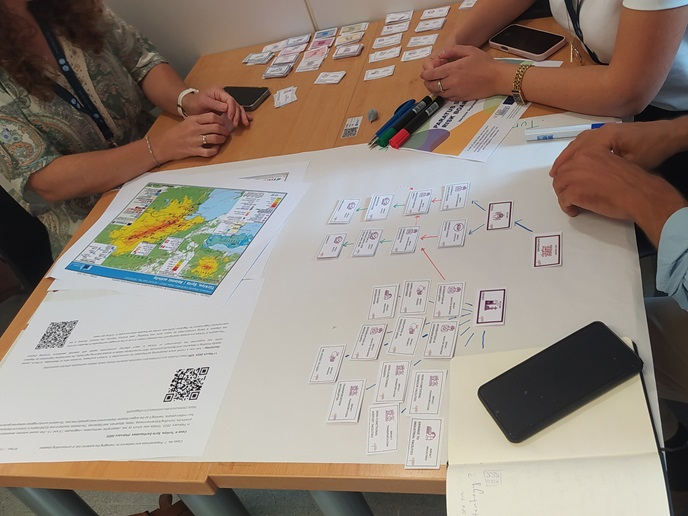
The PARATUS project also developed several serious games. For example, the PARATUS Systemic Risk Board Game(opens in new window) incorporates the various methodologies developed during the project and helps players see how they can be used to enable systemic risk assessments across different sectors. “The game helps players discuss and analyse cause-and-effect relationships and changing risk dynamics across the emergency response space and sectors and to develop scenarios and risk mitigation options together,” notes van Westen.
Practical solutions that ultimately benefit citizens
While the project’s solutions are already having an immediate impact on local disaster risk planning, its work also supports such long-term priorities as the European Green Deal(opens in new window), preparedness union strategy(opens in new window) and European Disaster Risk Management(opens in new window) framework. “PARATUS helps protect the European way of life by addressing safety, vulnerability and other challenges and by providing practical solutions that ultimately benefit citizens,” concludes van Westen. The PARATUS project’s work has inspired other projects and activities, including the ESA-funded(opens in new window) EO4MULTIHAZARDS(opens in new window) project and the DG ECHO-funded(opens in new window) project on development of a Master course on disaster management for professionals in Europe(opens in new window) (EUMA), amongst others.