Papyrus innovations bring ancient Egypt to life

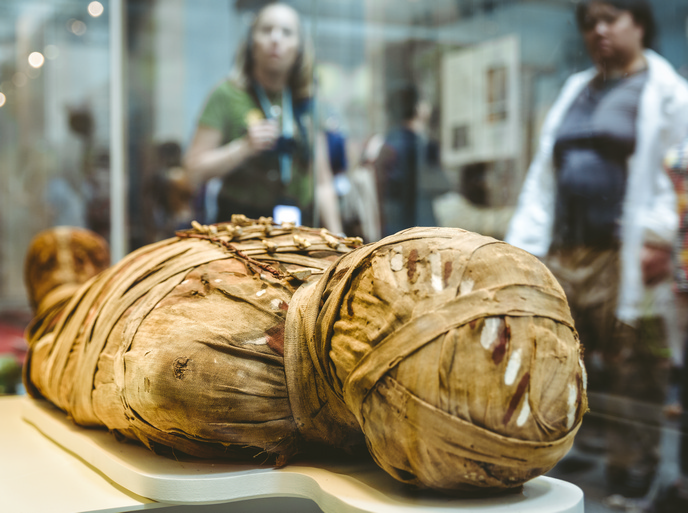
The GESHAEM(opens in new window) project focused on Egypt during the Ptolemaic period, and more particularly on third century BCE papyri (paper-like writing material made from papyrus plant) from the Fayoum region. These papyri were reused afterwards as mummy decorations called cartonnages. “Most of these papyri were administrative documents relating to the taxation system established in Egypt by the first Ptolemies,” explains GESHAEM project coordinator Marie-Pierre Chaufray from the École Pratique des Hautes Études in France. “The texts are mostly written in Egyptian Demotic, with summaries in Greek, and show how the administration drew on local expertise as well as Greek tradition.” A bilingual administration was developing in Egypt at this time, with many Greeks settling in the Fayoum region. Through studying these papyri and cartonnages, Chaufray and her team wanted to reassess the role of Egyptians in the largely Greek Ptolemaic administration and glean new insights into the evolution of funerary practices.
Deciphering and interpreting papyrus texts
The project, which was supported by the European Research Council(opens in new window), began by extracting and restoring papyri from badly preserved cartonnages from Sorbonne University’s Jouguet collection of artefacts. The papyri were photographed in colour and infrared and given to computer scientists, and an algorithm created to find connections between the numerous fragments. Once reconstructed, the texts were deciphered and interpreted by experts. “What made this project unique was the close collaboration between document restorers, Greek and Demotic papyrologists, Egyptologists, curators and IT specialists,” says Chaufray. “Each group listened to the needs of the others, and progress was made in unison.”
New insights into the Ptolemaic administration
GESHAEM restored 42 pieces of mummy decorations and inventoried 221 new fragments of papyri. A database(opens in new window) was developed, and part of the project’s results are published in a book for the general public(opens in new window) that now serves as a reference work for Ptolemaic Egypt. “GESHAEM has shed light on the Ptolemaic administration, and in particular on the role of Egyptians in the formation of the state,” adds Chaufray. The papyrus algorithm as well as an interface for manipulating fragments are now openly available. “GESHAEM is one of the first projects in the field of papyrology that has attempted to develop a software for connecting papyrus fragments,” says Chaufray. “This will save papyrologists considerable time.” Project findings were presented in several papers(opens in new window) and displayed in a final exhibition(opens in new window) in Bordeaux. Other results include a cartoon on papyrus production and reuse, as well as watercolours created for the Bordeaux exhibition by the artist J.-C. Golvin.
Resources for historians, linguists and philologists
A team of young scholars is continuing the work of publishing Demotic papyri from the Jouguet collection and searching for new bilingual archives with the help of members of GESHAEM. The GESHAEM database will continue to be updated so that newly published texts are easily accessible to all. “New data on agricultural operations, village communities and administration in the Fayoum can be used in broader studies by historians,” notes Chaufray. “Research on the Greek and Egyptian languages can also be conducted thanks to the numerous bilingual documents, which may be of interest to linguists and philologists.” Future projects could involve further excavations at the sites where the papyri were found, as well as improvements to the computer tools pioneered in GESHAEM.