Are we ready to rewrite the origin of writing?

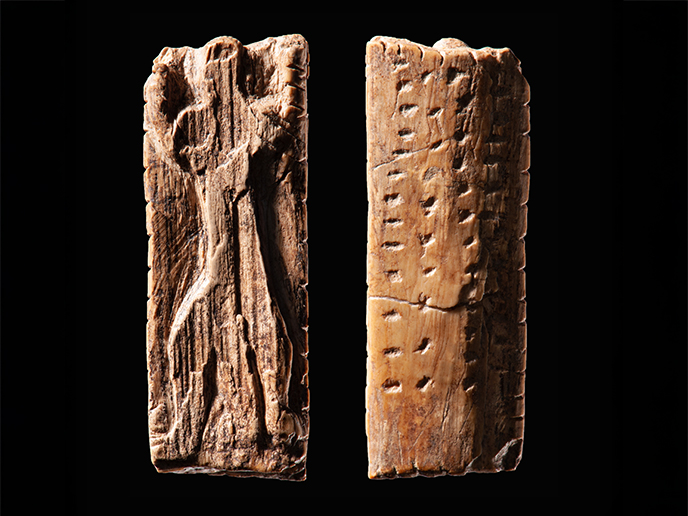
New evidence published in the journal ‘Proceedings of the National Academy of Sciences’(opens in new window) reveals that over 40 000 years ago, early humans were already marking their tools and sculptures with symbolic engravings. The symbols were engraved on artefacts that dated back to the Stone Age, when our species made their way to Europe from Africa and encountered our close relatives the Neanderthals.
Pushing back the history of writing
Some bear mystifying sign sequences, often repeated lines, notches, dots and crosses that demonstrate amazing cognitive abilities by ancient people for that period of time. Given that the earliest known form of writing emerged much later in Mesopotamia around 3300 BCE, these findings could redefine written communication’s history. “Usually when we talk about writing, it seems like this big, monolithic achievement that humans finally reach to become civilized,” archaeologist Ewa Dutkiewicz, curator and research associate at the Museum of Prehistory and Early History in Berlin, told ‘CNN’(opens in new window). “But when we look at the archaeological evidence, we see there is much more going on beyond written language.” The precise meaning behind these symbols has remained a mystery. Using computer-assisted techniques, Dutkiewicz and linguist Christian Bentz, professor at Saarland University in Germany, analysed over 3 000 signs found on 260 objects to learn more about writing’s beginnings. “There are plenty of theories, but until now there has been very little empirical work carried out on the basic, measurable characteristics of the signs,” explained Bentz in a news release(opens in new window). “Our analyses demonstrate that these sign sequences have nothing to do with the writing systems of today, which represent spoken languages and are characterized by high information density. In contrast, the signs on the archaeological objects are frequently repeated – cross, cross, cross, line, line, line. This type of repetition is not a feature found in spoken language.” Bentz further elaborated: “The human ability to encode information in signs and symbols was developed over many thousands of years. Writing is only one specific form in a long series of sign systems. We continue to develop new systems for encoding information. Encoding is also the basis of computer systems.” The new findings showed that these signs could hold roughly as much information as some language scripts that appeared thousands of years later. Even though the team couldn’t decode the signs’ exact meanings, they were likely used to convey information and record thoughts.
A precursor to writing
“Our research is helping us uncover the unique statistical properties – or statistical fingerprint – of these sign systems, which are an early predecessor to writing,” added Bentz. The two researchers visit museums and archaeological sites across Europe to uncover new Stone Age signs. “There are many sign sequences to be found on artefacts. We’ve only just scratched the surface,” Dutkiewicz concluded. Perhaps our shaggy Stone Age ancestors can shed the reputation of being mere club-wielding brutes. It’s high time we gave them the level of respect that they deserve after all these years!