The stories told by ancient bones are now more reliable

By studying ancient proteins extracted from archaeological and palaeontological materials, such as bones, teeth and tools, researchers can travel far further back in time than had been thought possible. This still novel area of science is called palaeoproteomics. But groundbreaking tools and approaches need to be evaluated carefully to ensure samples are analysed as effectively as possible, extracting every last bit of data while leaving behind the confusion caused by contamination. “After all,” says Zandra Fagernäs(opens in new window), “taking samples is always destructive to some degree, and archaeological finds are often rare and irreplaceable. At the same time, it is crucial to establish what material is contemporaneous with the epoch under study and what might be there as a result of more recent contamination. We need to know what exactly we are looking at.” Which is why Fagernäs, a postdoctoral fellow at the Globe Institute(opens in new window), University of Copenhagen, Denmark, decided to launch the PROMISE project. Maximising the efficiency of extraction and analysis of proteins preserved in archaeological bones and teeth will pay great dividends, as data can answer many questions, from the impact of prehistoric climate change to the evolution of species. “Proteins may differ between species: they can be used to identify from which species the material stems, as well as showing how various extinct and currently living species are related to each other,” notes Fagernäs, whose work was supported by the EU’s Marie Skłodowska-Curie Actions(opens in new window) (MSCA) programme. So every fragile sample counts!
Identifying contaminants and isolating target samples
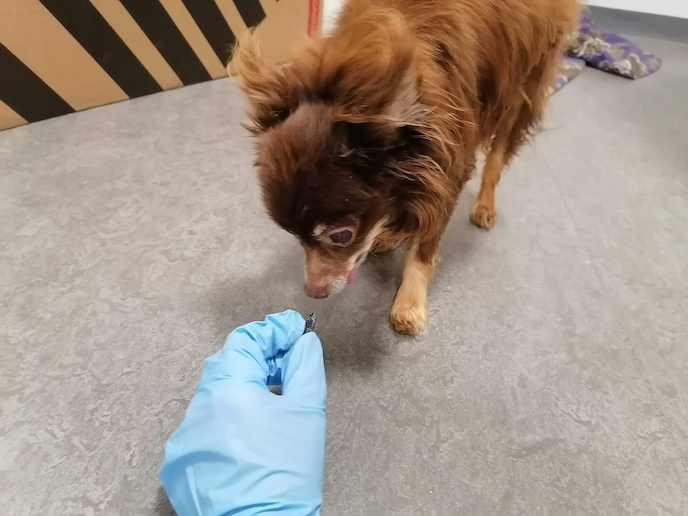
One of the factors that requires careful evaluation is the impact of contamination. Archaeological materials, such as skeletons, have often been contaminated from many different sources, such as the burial environment, handling and during storage. “Proteins from this contamination will be in a much more intact state than degraded, ancient proteins, and may therefore reduce the quality of our ancient data. For example, there might be much more of the contaminating proteins than the ancient proteins, and they can therefore simply swamp out any remaining ancient proteins,” adds Fagernäs. To explore how we best remove contamination, the team wanted to artificially contaminate an archaeological bone with a known material. But with what? Human skin contamination is so abundant that it would be impossible to control its origin precisely, and using a lab-produced pure protein would be too simple to approximate real contamination. “The answer came to me one day when I was walking my dog, Tjorven, who was drooling out of excitement for a fun evening walk,” notes Fagernäs. Dog saliva is the perfect material for artificial contamination, containing many different proteins which would not normally be found on an archaeological bone. Helpfully, the saliva comes from a species we can easily identify. Fagernäs recruited her dog to the project, and he got to work contaminating an archaeological bone so she could then test different methods of removing contamination in the lab; thereby proving the old saying is true, a ‘researcher’s’ best friend is her dog.
New methods to benefit the wider palaeoproteomic community
By applying various processes, Fagernäs was able to establish the most effective way of identifying and removing the contamination, leaving the target proteins behind and suitable for analysis. Many of the results from PROMISE will be applicable to the wider palaeoproteomic community, in terms of both the methods the team developed, as well as the approaches they took to devise ways of assessing the impact of contaminants. Fagernäs’s findings are set out in a paper she co-authored, published in the ‘Journal of Archaeological Science’, and titled ‘Cleaning the dead: Optimized decontamination enhances palaeoproteomic analyses of a Pleistocene hominin tooth from Khudji, Tajikistan’(opens in new window), as well as a follow-up study focusing on dental enamel, published in ‘Scientific Reports’, ‘Identification and removal of contamination in palaeoproteomic analysis of dental enamel’(opens in new window). As she explains: “The methods I developed, thanks to the support of the MSCA fellowship, can now be used by a range of researchers in many different archaeological and palaeontological contexts, improving our knowledge of our own evolutionary past.”