Humans aren’t alone in processing voices, monkeys can too

Voices are among the richest social signals, carrying not only speech but a wealth of non-verbal cues critical to social interactions. “When we hear a voice, we don’t just hear a sound, we hear a person, often from a single utterance, and it turns out other primates share this ability,” says Pascal Belin, coordinator of the COVOPRIM project, which was funded by the European Research Council(opens in new window). According to Belin, most voice research has focused on speech(opens in new window), leaving a gap in knowledge about non-verbal cues, despite their longer evolutionary history. So, COVOPRIM compared human and primate behavioural and cerebral aspects of voice perception, “to infer which mechanisms are conserved in evolution, and which are species-specific,” explains Belin from Aix-Marseille University(opens in new window), the project host. The results suggest that when our ancestors started using their voice for speech, their brains were already equipped with the necessary neural processing machinery.
Behavioural and brain testing of voice processing
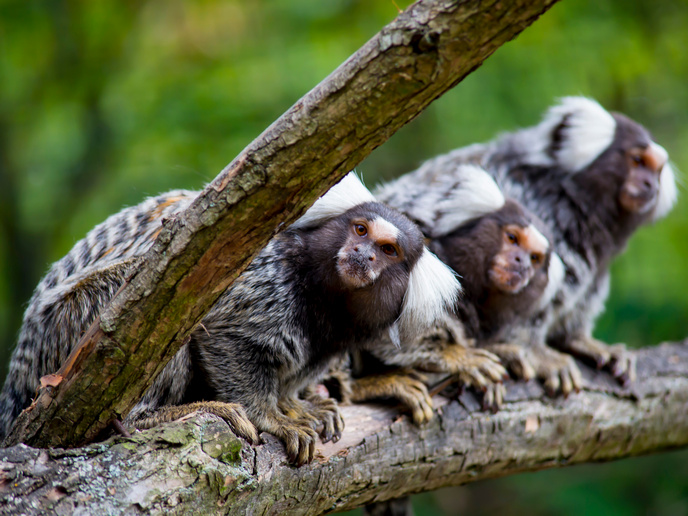
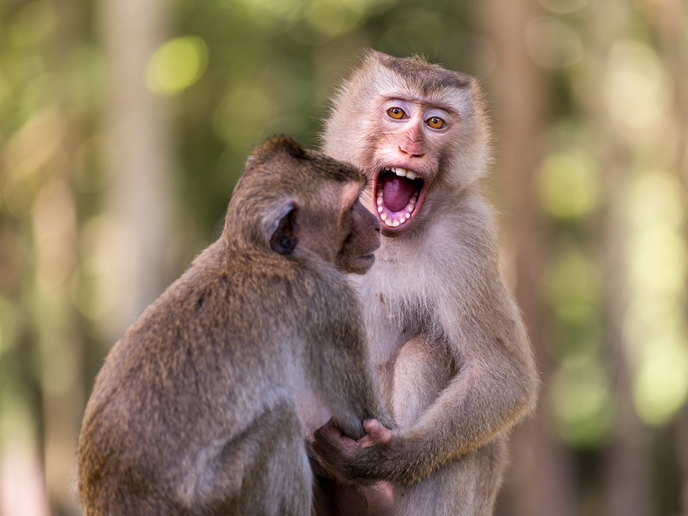
COVOPRIM used similar experimental procedures in humans and monkeys. Macaques and marmosets were chosen due to their wide use in neuroscience models, and as they exhibit a varied vocal repertoire. Providing two evolutionary human comparisons, macaque vocalisations are more similar to humans than their higher-pitched marmoset cousins. In one set of experiments, automated testing systems presented voice perception tasks of increasing difficulty. For instance, monkeys had to press a screen matching the voice stimuli, ignoring deliberate audio distractions. Completed without training or guidance, the monkeys had to develop their own strategies and were rewarded with treats, incentivising them to play millions of times. Humans were then tested in exactly the same conditions, with no verbal instructions. “We found a large variation in voice perception ability between both human and monkey individuals, so could quantify their sensitivity to voice cues, such as pitch,” notes Belin. In another experiment, the team used comparative functional MRI to scan human, macaque and marmoset brains. Using the same scanner and auditory stimuli (humans’ and monkeys’ voices, alongside non-vocal control sounds), the team demonstrated that human ‘voice areas’ also exist in these monkeys. “While it was known that the split between New World and Old World monkeys occurred around 40 million years ago, it was unknown whether the common ancestor possessed specialised brain structures for analysing vocalisations from same-species individuals. Our results suggest this was indeed the case,” adds Belin. Another series of experiments investigated the properties of individual neurons in the voice areas of macaques. High-density electrode arrays were implanted in the voice areas of three macaques. The team then recorded the activity of hundreds of neurons in response to voice stimuli. “We confirmed the existence of ‘voice cells’ in the macaque brain – neurons that respond selectively to macaque vocalisations – research that was little investigated before. We also unexpectedly discovered macaque neurons that seem selective for the human voice, firing at least twice as much as for non-vocal sounds! This is intriguing, since humans and macaques didn’t co-evolve. Perhaps explainable by the fact that laboratory macaques have heard human voices every day since birth,” remarks Belin.
Implications for pathology treatments
Belin suggests that COVOPRIM’s results could contribute to better diagnosis and treatment of conditions that affect voice processing, such as autism or schizophrenia. They could for example inform next-generation cortical implants for restoring or enhancing voice perception. “Now that we know where voices are processed, we plan to investigate how this happens: How are the voice cells organised? What are their computational mechanisms? How plastic are they? Are these neurons necessary for perception?” says Belin.