How AI can add a personal note to music education

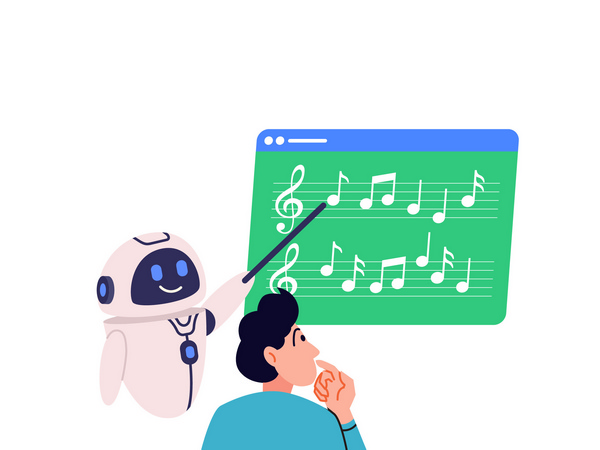
While education in general embraces new technologies such as artificial intelligence (AI), music education remains a rather analogue endeavour. “Music education is largely carried out as it was before the personal computer – via a combination of one-on-one lessons and solo practices and using established method books,” says Filippo Carnovalini, a Marie Skłodowska-Curie Actions postdoctoral fellow(opens in new window) at VUB(opens in new window). The problem with this approach is that these books cannot be adapted to the ability and needs of individual learners. This is where AI could play a role. “We believe that AI has the potential to personalise musical education by generating tailored exercises for every beginner musician,” adds Carnovalini. Working to put that potential into practice is the EU-funded CALIOPE(opens in new window) project.
AI not being used to generate tailored music lessons
To start, researchers conducted a comprehensive overview of how often AI is used for the personalisation of music education. “What we found is that, while there seems to be a clear interest in using AI for music education and personalisation, the technology is not used to generate tailored exercises,” explains Carnovalini, who serves as the project coordinator. Researchers also found that, of the few programmes that do generate lessons, most are limited to retrieving material from existing databases or generating complementary aspects such as visualisations or feedback, rather than the educational material itself.
A personalised view on how difficult a musical piece is
Based on this research, the project determined that, to be truly beneficial to music education, AI must do more than simply generate music. “Generative AI can already do good music generation, but it typically lacks the level of control over the output that is needed to be useful in the specific use cases offered by education,” notes Carnovalini. According to Carnovalini, the solution is to embed generative AI programmes with ways to describe a personalised view on how challenging a piece is for a specific student. To do so, the project developed an innovative cognitive model for determining difficulty based on a learner’s experience. “While there are other ways to estimate the difficulty of a musical piece, our cognitive model allows us to describe different expectations for different people based on their different experiences in playing,” remarks Carnovalini. “The net result is a personalised view on difficulty that can then be used to generate tailored musical lessons.”
Making music education more effective
While the project’s models and results are not at a technological readiness level fit for deployment in schools and homes, they open the door to making music education more effective and less frustrating for beginners. “Every learner is different, so every student deserves different exercises,” concludes Carnovalini. “AI solutions such as those developed by the CALIOPE project have the potential to make that possible.” Following further experiments, researchers hope to evolve some of the project’s solutions into user-friendly applications. Details about the project’s work are available online(opens in new window).