Hybrid collective intelligence: where humans and machines meet

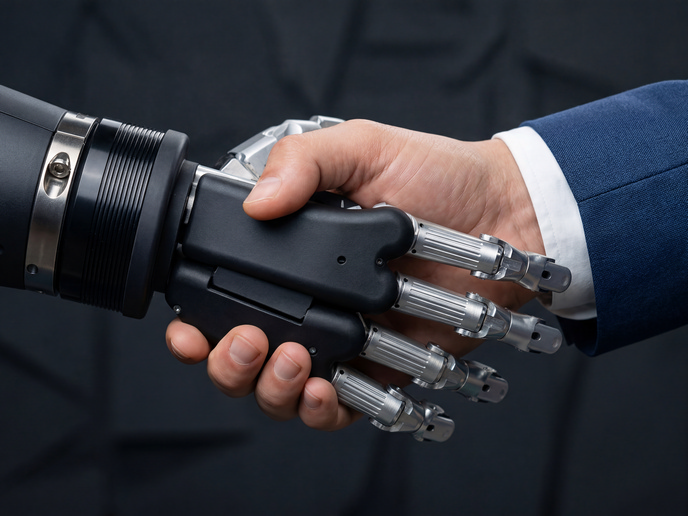
The popular narrative around artificial intelligence (AI) is that it’s humans versus machines – you can have either one or the other. But in reality, it will likely involve a little of both. “The future will see a blend of human and machine intelligence, where AI serves as a support tool that empowers, rather than removes, humans from the decision-making loop,” says Vito Trianni, a researcher at the Institute for Cognitive Sciences and Technologies – National Research Council(opens in new window) (ISTC – CNR) in Italy. This blend is called hybrid collective intelligence, a collaborative system that combines human expertise, creativity and intuition with the computational power, speed and analytical rigour of AI. Helping to put such a hybrid system into practice is the EU-funded HACID(opens in new window) project.
Adding AI to the collective decision-making mix
Building on existing research about human collective intelligence, HACID adds AI into the collective mix to achieve better decisions. The project proposes a framework where decision support is provided both by AI and by other human experts, each of whom independently contributes to finding a collective solution. “Our approach exploits structured, semantic knowledge to aggregate solutions provided by different experts – be they humans or machines – to produce collective decisions that are better than any individual alone,” adds Trianni, who coordinates the project.
Supporting medical diagnostics
The project applied its framework to two different application domains: medical diagnostics and climate services. The former, carried out in collaboration with Human Dx(opens in new window), allowed researchers to understand how AI can support physicians in complex diagnostic reasoning. “We provided one of the few empirical demonstrations that a team of human experts, working together with AI, can produce a real synergy that exceeds the performance of either agent acting alone,” explains Trianni.
Making sense out of climate change
Working with the United Kingdom’s Met Office(opens in new window), researchers also used the framework to help climate scientists better understand how best to provide future climate projections used in climate change adaptation strategies. “Here we developed a semantic knowledge graph and generative AI tools that climate scientists can use to produce actionable workflows for retrieving climate information relevant for adaptation management,” notes Trianni.
Hybrid collective intelligence is the technology of the future
AI is moving fast. According to Trianni, when the project started, ChatGPT didn’t exist. Today, many sectors couldn’t imagine working without its support. “This goes to show that hybrid collective intelligence is the technology of the future – a future that HACID has helped shape,” he says. That being said, Trianni acknowledges that the project only just scratched the surface of hybrid collective intelligence. This is why researchers continue to study and develop support systems, not only for medical diagnostics and climate services, but also for such sectors as insurance, law and policymaking. “We need to develop more complex forms of AI support that are not limited to providing ready-made solutions, but that can accompany human experts and teams in their most critical decisions,” concludes Trianni.