Automated fast charging keeps electric ferries on time


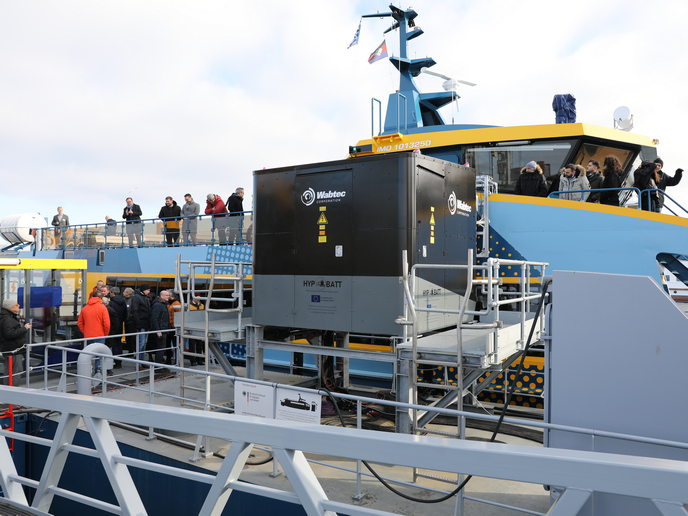
Battery-electric ferries can cut emissions and noise, but they must recharge during short port stops without disrupting passengers or damaging batteries. Ports also need equipment that can cope with vessel movement, grid limits and different ship designs. This supports the International Maritime Organization’s emissions strategy(opens in new window) and Europe’s expansion of shore-side electricity. The EU-funded HYPOBATT(opens in new window) project, coordinated by the research centre IKERLAN, developed a modular multi-megawatt charging system for electric vessels. It combines automated connection, power conversion, battery-aware control and digital tools for port operations. The Norddeich-Norderney ferry route operated by Frisia provides the project’s full-scale maritime case.
Automated ferry charging connects despite tides and wind
A ferry cannot line up with a quay as rigidly as a car can park beside a charger. Endika Bilbao, HYPOBATT project coordinator and senior researcher in IKERLAN’s Energy Storage and Power Electronics Department, explains: “First, the vessel is not fixed: tide movement, wind and mooring tolerances continuously change its position relative to the quay, so the system must align and connect repeatably.” The automated connector must then transfer high current with low resistance in a salty environment. Contact surfaces, alignment and communication are central to connecting safely with little manual intervention. Earlier EU-funded research on fully electric ferries showed why charging must begin quickly during loading and unloading.
Fast charging protects batteries and ferry timetables
Faster charging can help a vessel recover enough energy during its normal stop, protecting the timetable when boarding, manoeuvring, weather or congestion causes delays. Bilbao says: “Battery protection was one of HYPOBATT’s critical KPIs, and the project has met this objective by treating fast charging as an energy-management problem, not simply as delivering the highest possible power.” Charger control and a digital twin adjust the charging profile based on battery temperature, and state of charge, as well as grid power capabilities. This supplies the energy required for the route while avoiding unnecessary stress and lifetime loss. It also provides port operators with evidence on connection times, availability, grid compatibility and operation under a ferry schedule.
Common megawatt charging lowers port investment risk
HYPOBATT implemented the Megawatt Charging System (MCS) industry standard in its full-scale maritime case. Standardised interfaces and communication matter because ports cannot justify separate infrastructure for each vessel or operator. As Bilbao puts it: “A common standard reduces investment risk, avoids duplicated infrastructure, and allows charging systems to serve different vessels and operators.” That approach supports the interoperability sought by the EU’s Alternative Fuels Infrastructure regulation(opens in new window) and complements the FuelEU Maritime regulation(opens in new window). Modularity also allows charging capacity to reflect vessel schedules, port layouts and grid conditions. By coordinating charging windows with renewable electricity, storage and other port loads, high-power chargers could support shared infrastructure and energy service business models. HYPOBATT therefore links charging technology with port operations: ports can become energy hubs that keep electric based maritime transport reliable, scalable and easier to invest in.