Solar-powered purifier delivers clean water to off-grid communities

Nearly 2 billion people worldwide still lack access to safe drinking water(opens in new window). Climate change, overconsumption and pollution are making it more difficult as water sources are becoming more saline and/or contaminated. While technologies such as reverse osmosis have transformed desalination, they require electricity, specialist maintenance and costly replacement parts, making them difficult to operate in many remote and low-income communities. The need is particularly acute in smaller and off-grid communities, where conventional desalination is often impractical. The SAFEWater-SDCW project, funded by the European Innovation Council(opens in new window), has taken a different approach. Led by Dutch company SolarDew(opens in new window), the researchers have developed a solar-powered water purification system that uses the sun’s heat rather than electricity to remove salts, heavy metals, bacteria and viruses from contaminated water. “People need a solution that is simple, affordable, robust and easy to use and that is where SolarDew comes in,” says Alexander van der Kleij, CEO and co-founder of SolarDew. The work reflects the wider ambitions of the European Water Resilience Strategy(opens in new window), which promotes innovative solutions to improve water security and make communities more resilient to climate change.
Mimicking nature to produce clean water
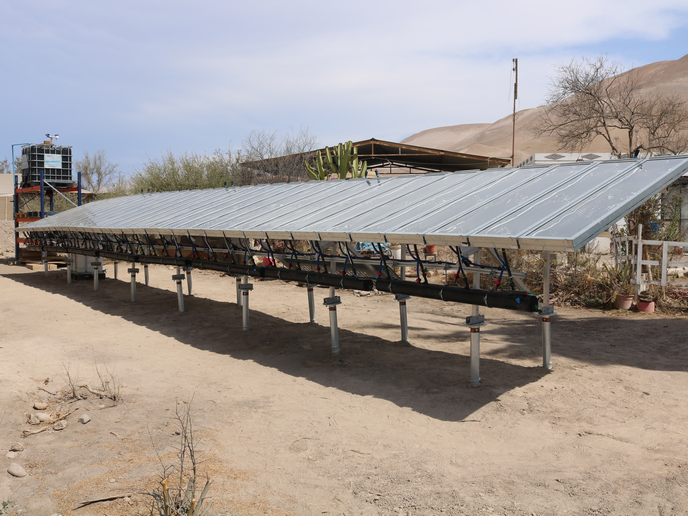
Although the system resembles a solar panel, it produces drinking water instead of electricity. Contaminated water is heated by the sun and evaporates through a specially designed membrane. The resulting water vapour is then condensed into clean drinking water before being remineralised to improve both taste and health. Unlike many existing systems, the technology requires no external electricity, high-pressure pumps or chemicals to clean the membranes. “Less is more,” explains van der Kleij. “There are no complex systems that can break down and are difficult to service and repair in rural areas.” Over the course of the project, the team refined both the membrane and the manufacturing process. By integrating the membrane into an innovative water purification bag manufactured using techniques from the packaging industry, they created a system that is significantly cheaper to produce while remaining durable and easy to scale up. The technology has also demonstrated its ability to remove a wide range of contaminants. Alongside seawater desalination, tests successfully removed naturally occurring contaminants such as arsenic from brackish groundwater, opening opportunities for communities facing different types of water quality challenges.
From demonstration to deployment
The research has now moved beyond laboratory testing. Demonstration systems have been installed in Chile and on the Greek island of Crete, while discussions are underway with communities and partners in Kenya and other regions affected by water scarcity. These pilot installations are helping the team understand not only how the technology performs under real-world conditions but also how it can be manufactured, installed and maintained at scale. “The next two years are focused on learning and improving the product in terms of manufacturability, project implementation and ease of use together with our partners and clients to ensure that it matches all the requirements and to reduce cost,” says van der Kleij. Looking ahead, the researchers are exploring new business models, including ‘water as a service’, to make the technology affordable for communities that cannot purchase systems outright. Their long-term ambition is to create a blueprint for deployment in water-stressed regions worldwide. “I think decentralised technologies, like SolarDew, have a much bigger role to play, in a similar way that solar panels did for energy provision,” says van der Kleij. “By offering new technologies and creating awareness that there are alternative solutions to solve these issues for those who are currently being left behind, we hope to create healthier, more sustainable and climate-resilient communities around the world.”