Retracing our ancestors’ first steps out of Africa

For decades, the story of how our earliest ancestors made and used tools, then spread out of Africa into Asia and Europe, has rested on a patchwork of assumptions. A wave of new discoveries and increasingly precise dating techniques is now putting those assumptions to the test. Long-standing models linking new hominin species, cultural innovation and human dispersal to shifts in climate have largely remained theoretical – until now. Hard evidence from the field, paired with statistical modelling, is finally allowing researchers to test these ideas directly. “We aimed to get the big picture of how our early ancestors first dispersed from our cradle in Africa into Asia and Europe, and how they adapted to changing environments and ecological challenges,” says Ignacio de la Torre(opens in new window), principal investigator of the BICAEHFID(opens in new window) project which was conducted at the Spanish National Research Council, known as CSIC(opens in new window).
Stone tool strategies challenge a ‘static’ Asia
One of the project’s central findings is evidence of unexpectedly complex stone tool knapping strategies in northern China. “The discovery challenges a long-standing view of the region’s archaeological sequence as comparatively static, suggesting that early hominins in Asia were experimenting with more sophisticated techniques than previously assumed,” notes de la Torre.
Bone tools 1.5 million years old
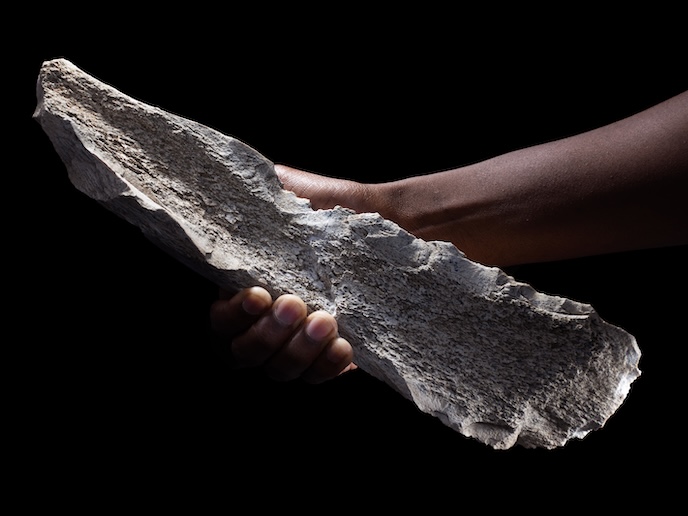
In eastern Africa, the team has identified the earliest evidence yet of systematic bone tool technology, dating back 1.5 million years. The find shows that early humans could carry knowledge and skill from working stone raw materials over to working bone(opens in new window) – a more flexible, transferable technical repertoire than researchers had previously credited them with. As de la Torre, head of the CSIC-Pleistocene Archaeology Laboratory(opens in new window), with research focused on the Archaeology of Human Evolution, explains: “Our intensive fieldwork in uncharted, and also previously known areas, led to the discovery of new archaeological sites. “Additionally, novel dating techniques have enabled obtaining radiometric ages that push back the origins of stone and bone tool technologies.”
Testing old ideas with new tools
Questions about which hominin species made the earliest stone and bone tools, and which were the first to migrate from Africa into Asia and Europe, have long been difficult to settle. The European Research Council(opens in new window) has supported a number of other projects looking into the question, such as the role prehistoric diseases played. By combining fresh fieldwork with statistical modelling, BICAEHFID can now test long-standing hypotheses directly against the hard evidence, rather than relying on inference alone. “This project shows that our ancestors were transferring the same knapping know-how from stone to bone, much earlier than we ever suspected,” adds de la Torre. “It’s a reminder that our species’ spread across the world was shaped as much by adaptability as by climate.”