A new route to geostationary orbit for small satellites

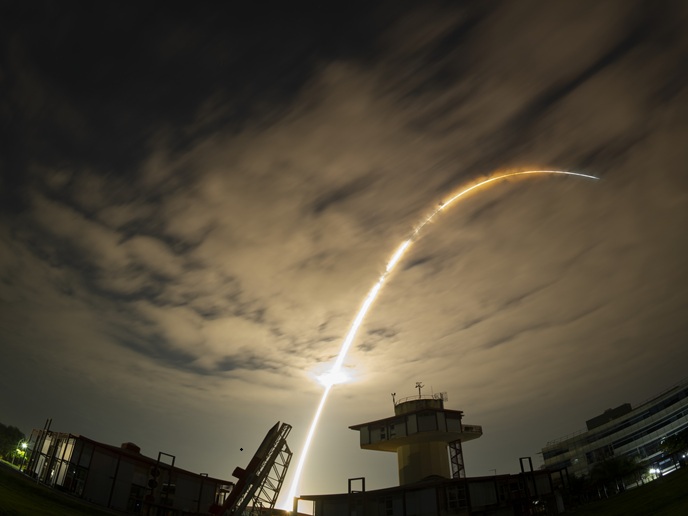
Don’t be fooled by their size, small geostationary orbit (GEO) satellites pack a big punch. Smaller and lighter than conventional GEO satellites, these spacecraft are estimated to offer as much as a fivefold reduction(opens in new window) in the cost of sovereign satellite communications. To enjoy these cost-efficiencies, the satellites must first reach GEO, 35 800 km above the equator. This is an expensive and complex two-stage process, one that many EU Member States don’t have ready access to. “Geopolitical factors and Europe’s reliance on non-European launches for reaching GEO limits its ability to compete in the new space race,” says Rafael dos Santos, project manager at France’s Infinite Orbits(opens in new window).
Shifting the space transport paradigm
The GEORyder project is helping Europe to surpass these limits. A consortium of eight partners led by Infinite Orbits, the project aims to deliver Europe’s first reusable vehicle for transferring small satellites to GEO. “We want to shift the space transportation paradigm from direct rocket launches to flexible, in-space logistics,” notes dos Santos, who serves as the project coordinator. The proposed orbit transfer vehicle (OTV) is designed to deliver small satellites (those weighing under 400 kg) from an intermediate geostationary transfer orbit (GTO) to the final stable GEO. The project successfully built and conducted on-the-ground testing of the OTV’s main structure and systems, ensuring the system can handle both the launch and space conditions. The project then tested the spacecraft’s smart camera systems and automatic navigation software in hybrid simulations, showing that it can safely deliver satellites to their target orbit. “We also created a plan to build these spacecraft faster and more affordably by using standardised off-the-shelf parts and streamlined assembly lines,” adds dos Santos.
Not just new space, but green space
What sets the GEORyder solution apart from other OTVs is its choice of fuel. Thrusters developed by project partner Dawn Aerospace(opens in new window) use a clean-burning propellant based on nitrous oxide that is safer to handle than traditional fuels. These propellants also shorten the transfer time from three months to just two to three weeks, drastically reducing exposure to ionising radiation in the Van Allen belts. “Small satellites aren’t normally tolerant of high radiation doses,” explains dos Santos. “A rapid transfer allows simpler satellites to survive the transfer, facilitating their access to GEO.” The GEORyder OTV is also unique in that it features a standardised docking port for in-space refuelling, giving it the potential to make multiple transfers with a single launch.
A blueprint for building a more competitive space sector
Not only has GEORyder proved that affordable, rapid GTO-to-GEO delivery can be achieved using reusable spacecraft powered by green chemical propulsion, it delivered a blueprint for building such spacecraft. “By developing reusable, cost-effective and commercially viable spacecraft in Europe, GEORyder strengthens Europe’s industrial base and enables European companies to compete in the rapidly evolving new space market,” concludes dos Santos. The project is now working to prepare its solutions for in-orbit demonstration missions and commercial last-mile delivery services.