


On-line inspection and control of work roll surface

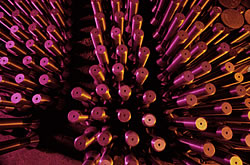
Semi-finished steel products are transported to rolling mills for generating flat or long products, including plates, welded tubes, rolled coils, rods and bars. Despite their importance, these activities appear to be significantly expensive, especially due to wears that increase roll consumption during surface repairs. Additionally, it takes a considerable time and effort to change rolls, which also decelerates production. The degradation of the work roll surface is an important parameter that needs to be inspected and controlled throughout rolling sessions. For this reason, this project developed a computer assisted visual system that includes a Charge-Coupled Device (CCD) camera. A stroboscopic light source for camera sensitisation allows light's synchronisation with the periodic movement of the work roll surface, making it appear almost stationary. Employing a lens with motorised focus adjustment, the system allows advanced inspection that meets increased detail observation requirements. Not only does the system enable direct observation (an area of 6mmx8mm), but also capture of CCD images during rolling. Moreover, the operator can acquire images of any preferable quality, at any preferable rate and with many correction possibilities with the specialised developed software. Additional external signals ease the synchronisation of image capture with rolling sequence and the observation of a specific spot of the roll surface. The acquired image can be displayed on a computer and stored on a regular basis at specific time intervals of the rolling workflow. This enables the analysis of the evolving work roll degradation according to processing parameters for extending the length of sessions and limiting defects on products.