New VCR engine reduces fuel consumption

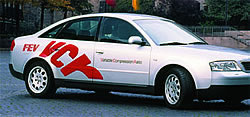
A German company has produced a 1.8 litre VCR engine that is expected to replace higher displacement engines like the 3.0 litre natural aspirated engine. Supercharged VCR engines are classified as one of the more famous gasoline engine concepts for the future, and it is expected that by 2008 they will have about 5% of the market share. The VCR approach reduces pumping and friction losses by moving the operation point to a lower engine speed/higher load by engine downsizing. To accomplish this with up to 30% reduction in fuel burn when compared to a 1998 engine, it was necessary to utilise a down sized highly boosted engine with VCR. Hence the goal was to experiment with a series of single-cylinder engines with varying VCR mechanisms in addition to multi-cylinder test benches and in-vehicle investigations. This in turn led to the development of the FEV's 4-cylinder 1.8-litre turbocharged VCR engine and its subsequent vehicle integration. The FEV VCR concept has been thoroughly investigated and demonstrates good mass production practicalities, whilst it can also be adapted to existing engine families. Moreover, its comparability for mechanism based costs are much lower than other VCR engines with vehicle test results revealing an 8% fuel consumption saving. Additional fuel savings of about 18% have been achieved with the reduction of engine displacement. Thus a 1.8 litre FEV VCR engine when compared to 3.0 litre natural aspirated engine realises nearly 27% less in fuel consumption. Furthermore, the FEV VCR concept achieves all this without reducing driveability, and with only moderate increases in production costs.