Focusing on thermal neutrons

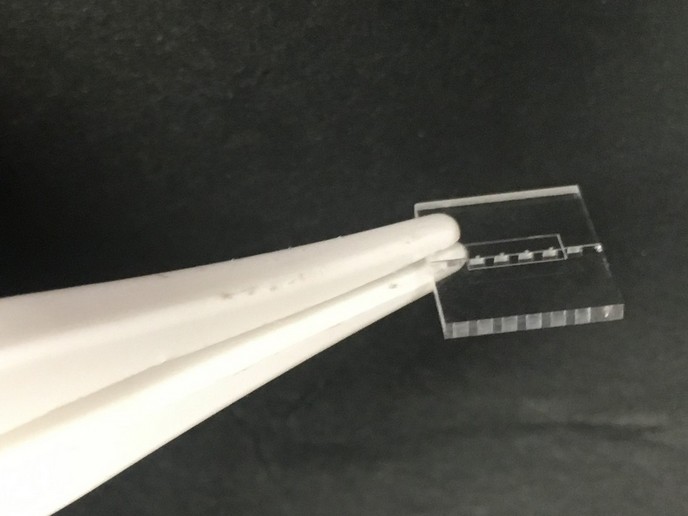
Highly penetrating neutrons can facilitate the non-destructive investigation of the interior of materials, even of complex, soft biological structures. Neutrons also enable investigation of light atoms, such as hydrogen, in the presence of heavier ones. In addition, their magnetic properties are ideal for the study of microscopic magnetic structures. The TECHNI project aimed at supporting neutron research at European facilities by developing more effective technologies for neutron detection, optics, and collimation. This is expected to improve not only the scientific quality offered by neutron scattering instrumentation, but also the currently available volume access. Within this project, an innovative focusing device for imaging thermal neutrons has been designed and tested successfully. The Neutron Silicon Lens (NSL) has been developed on the basis of using stacks of supermirrors supported by silicon wafers. Hence, NSL comprises several layers, each being a wafer of single crystal silicon coated with a neutron supermirror. The layers are of different thickness and come in an optimal stacking arrangement for converging all neutrons incident upon the lens within an appropriate angular divergence range. Each neutron is reflected only once allowing a line source to result to a line image of good quality. Moreover, by properly combining two NSL, point sources can also be imaged. The NSL device, the design of which has been patented, has been found suitable for time-of-flight instrumentation where neutrons of different energies travel with different velocities. By measuring the flying time of neutrons, it is possible to estimate neutron velocity, and hence, energy and wavelength. The analysis of these properties provides valuable information for obtaining the microscopic information on the matter, in terms of atomic structure, atomic vibration and magnetic spin configuration.