Robots that mind the gap

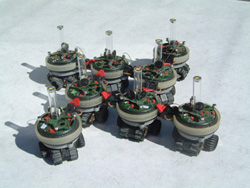
Robots perform tasks such as displacement, exploration or object transportation under different environments and operating conditions. In search of a high degree of mobility, versatility and robustness, researchers used the social insect metaphor and the self-assembling and self-reconfiguration abilities displayed when they transport objects or build nests as a model. This led to the design and implementation of robotic systems composed of swarms of robots that interact and cooperate to reach their goals. A swarm-bot is a self-assembling and self-organizing artifact, composed of several mobile robots (called s-bots) that can operate both autonomously and as a group. The system as a whole can dynamically self-assemble into different structures to perform certain tasks and then de-assemble into its s-bots components as necessary. Coordinated motion is a basic ability that the swarm-bot should display. Since the swarm-bot is composed of a number of independent entities, they have to coordinate their actions in order to move coherently across the environment. In this direction, each s-bot is provided with a traction sensor placed at the turret-chassis junction. The traction sensor detects the direction and the intensity of the traction force that the turret exerts on the chassis. The traction sensor integrates all the pulling/pushing forces created by the movement of the connected s-bots. In this way, it provides an indication of the average direction toward which the swarm-bot is trying to move as a whole in relation to the direction in which the individual s-bot's are trying to move. Extensive experiments have been carried out for the evolution of artificial neural networks capable of controlling the behaviour of such swarm-bots in a coordinated manner. The results are promising since they demonstrate that the evolved s-bot controllers exhibit obstacle avoidance behaviour. Furthermore they were proved to be robust in varying terrain roughness or in the presence of moderately sized holes.