Elemental analysis of historical documents

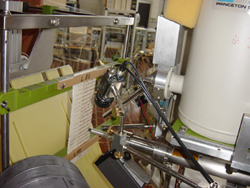
A large part of Europe's vast cultural heritage has been recorded with iron gall ink, from symphonies to artwork to historically important documents. While iron gall ink was easy to produce and not easily erasable, over time it destroys the paper on which it's used through a series of complex chemical reactions. Looking to protect this important legacy, the Fifth Framework Programme funded eight organisations (museums, universities, research institutes, etc.) to discover new methods of analysis and preservation. Physicists with the Institute Jozef Stefan (IJS) in Slovenia employed Non-Destructive Techniques to determine the elemental composition of inks. IJS used its TANDETRON accelerator to generate high-energy ion beams in a technique called Proton Induced X-ray Emission (PIXE). Scanning the beams across the document surface enables quantification of various metals present in the inks used. Since ancient recipes used to create gall ink varied, it is necessary to examine each document separately in order to prescribe a suitable treatment. The PIXE technique developed by IJS satisfies the crucial requirement that the sample remains intact and also boasts speed and accuracy. During the InkCor project, IJS analysed a large number of documents with PIXE. Over 800 data points have been collected in a database that forms part of the decision-making process established during the project. IJS is looking to initiate partnerships to exploit the PIXE technique and this database.