Effective monitoring operations of a solar chemical plant

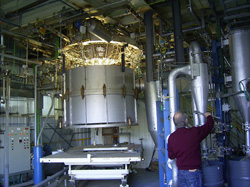
The ever increasing depletion of fossil fuels has created new demands to exploit other energy sources. Solar energy is found abundantly in nature, yet it constitutes an intermittent energy source. Challenged by this the SOLZINC project focused on bringing forward the concept of storing sunlight in the form of chemical energy by reducing zinc oxide to zinc. In turn, zinc becomes an energy vector that produces electricity in zinc-air fuel cells or it can be used as commodity zinc. For this purpose the technical feasibility of a solar chemical reactor that produces zinc from zinc oxide and carbon as a reducing agent in a 0.5MW plant was sought. Among the project results a complete system for monitoring processes of a solar chemical plant was developed. The system allows monitoring of the behaviour of various custom complicated systems with parts operating at high temperature. For instance, the parts of a 500kg-capacity chemical reactor and a 50kg/h metallic powder zinc quenching system. The instrumentation setup offers monitoring of the key operating parameters that are vital for running the plant. It may also provide comparisons of the real system's behaviour against predictions from modelled behaviour. The system allows optimisation of the plant operations by monitoring approximately 150 key parameters, without including all the auxiliary systems. These parameters include low to high temperature parameters of solids, liquids and gases, pressure of gases, flow rates of liquids and gases, as well as, real time gas composition analysis. The system can be exploited for data collection in order to achieve effective process control either in real-time or after analysis. Additionally, it may significantly assist in the improvement of the theoretical models using real measurements and may be used for further development and economic studies. The PROMES-CNRS has improved its current knowledge on high temperature solar based chemical processes instrumentation and monitoring. Its expertise can be employed for improving other high temperature processes. For further information click at: http://solar.web.psi.ch/data/research/elprod/elprod.html(opens in new window)