



Assessing metals for lead-free soldering

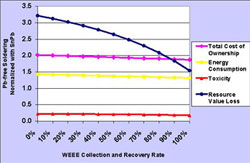
European regulation and market demands stimulate a global movement toward the need for lead-free soldering in the electronics industry. Hence, the EC-funded project EFSOT has undertaken the promotion of reliable, efficient and sustainable lead-free soldering which also improves competitiveness. Companies and institutes explore scientific and technological material and work on issues for new advanced lead-free applications. At the same time, effects of substance and procedure alternatives and developments on environment, toxicity and resources were evaluated. Thus, as lead-free solutions are integrated, industry can select materials and processes having the most suitable technical requirements, the lowest life cycle impacts and with less resources. EFSOT has produced an assessment of the impact lead-free soldering in the electronics industry has on sustainable development. They specified sustainable development with regard to toxic discharges, energy consumption, metal resources, cost and a resource consumption provision for soldering. Additionally, new methodologies were introduced taking into consideration the particular demands of sustainable development. It was found that lead-free soldering reduces the toxic potential of WEEE (Waste electrical and electronic equipment) and PWBs (Printed wiring boards) at the end of life stage. Furthermore, a new efficiency approach reveals that the use of bismuth increases the efficiency of mining, but decreases the eco-efficiency of soldering. Data regarding the performance of the recycling and smelting infrastructure in Europe came about from an in-depth study. The obtained results aided the calculation of further metal consumption in lead-free solders compared to conventional soldering. Further increases of the global collection and recycling rates of WEEE are needed. The same is true for improvements in the recycling performance of tin and other metals.