


EU project produces high-speed 3D scanner
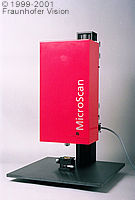
A digital mircromirror device, capable of providing high quality three dimensional imaging of a living cell has been developed in an project supported by the European Commission under the CRAFT subdivision of the Fourth Framework programme. The digital micromirror device (DMD) has been developed by seven partners from three EU Member States, in a project which is close to conclusion. DMD represents a more cost effective and efficient way of achieving three dimensional cell imaging. 'The quality of the image obtained from a confocal microscope can be adjusted by varying the pattern and speed with which the light scans the object,' said Frank Bitte, project partner from the German Fraunhofer Institute for Production Technology (IPT). 'This, however, requires the use of different Nipkow disks. Changing them is a time-consuming procedure and often not performed. More flexible, the DMD can be easily adjusted electronically. Moreover, with the DMD, there is no interference from vibration or friction, as occurs with the rotating disks. Data has previously been acquired using a confocal microscope with a closely focused beam that scans the cell point for point and layer for layer. A rotating disk containing tiny holes allowed light to pass onto the section of the scanned object, whilst blocking out the light both ahead and behind it. The new device uses almost 800 000 programmable micromirrors. Each mirror is 16 µm² and can be individually set to an angle of plus or minus ten degrees, thus allowing more flexibility. In addition to the standard use of DMD in the field of digital video projection, the device could also be put to other uses, for example the measurement of bifocal contact lenses or checking for wear on DVD discs or CDs. The product is expected to be introduced to the market by one of the project partners in 2002.