


Busquin signs EU-Russia energy and space deals
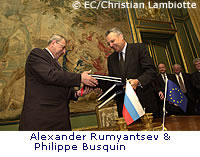
European Research Commissioner Philippe Busquin signed deals with Russia on energy and space research cooperation during the visit to Brussels by Russian President Vladimir Putin on 3 October. Commissioner Busquin met up with Russian atomic energy minister Alexander Roumyantsev to sign two cooperation agreements on nuclear fusion and fission energy. The deals form part of Mr Busquin's strategy to open up the proposed European research area to third countries and foster collaboration with the Russian Federation. The agreement on nuclear fusion centres on research into the generation of energy through controlled nuclear fusion and the development of technology to build a suitable reactor for this process. The EU-Russia agreement may be seen as an attempt by Russia to bolster their position as a potential host country for the fusion reactor. Russia is one of countries which have expressed an interest, alongside France, Japan and Canada, in hosting the reactor site, which would bring scientific and economic benefits. Nuclear fusion, which has the potential to provide a safe, sustainable, greenhouse gas-free source of power generation, has proved a hot topic in recent years, with the Commission proposing to pour 700 million into fusion research under the next RTD framework programme, FP6. Nuclear fusion could also be a key element in addressing potential EU future energy problems. Opening a conference on renewable energy in Brussels on 25 September, Commissioner Busquin said that currently, 50 per cent of EU energy is imported. According to the estimations of the Green Paper on the European strategy for energy supply security, he added, this dependence of the Union could rise to 70 per cent by 2020-2030, a situation that could be further accentuated by EU enlargement. The agreement on nuclear safety centres on reactor safety, radiation protection, nuclear waste management, the decommissioning of obsolete installations and the control of nuclear material. Cooperation in the nuclear safety and fusion agreements, which have an initial duration of ten and five years respectively, will focus mainly on the exchange of technical knowledge, experts, materials and equipment, as well as training and joint studies. Both agreements will be overseen by joint working groups. Commissioner Busquin also cemented the long-standing space cooperation between Europe and Russia by signing a joint document on the Euro-Russian Space Partnership with Russian space agency director general Youri Koptiev. The deal will focus on satellite navigation systems such as Galileo and Glonass, Europe's 'global monitoring for environment and security' (GMES) initiative and launch services, notably the launch of Soyuz rockets from the European Space Centre in Kourou, French Guiana. The partnership will also include new space programme activities including crewed missions, planetary exploration, the development of future transportation systems and use of the International Space Station. The deal will be monitored by a high level steering board, which will implement the partnership and ensure each joint programme meets set goals and standards. It will also oversee the fair and cost-effective division of activities and the sharing of results and benefits.