


Liikanen welcomes study showing bright future for European e-commerce
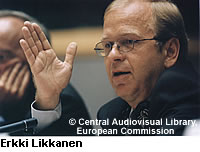
European Enterprise Commissioner Erkki Liikanen has welcomed a new study which shows that European e-commerce is thriving in spite of the bursting of the dotcom bubble. The survey of executive attitudes to e-commerce by management consultancy Accenture found that 50 per cent more European executives than in 2000 report that their e-commerce activities have been successful and over 80 per cent of executives questioned in Europe, the USA and Japan expect to experience further growth in e-commerce over the next three years. European executives also predict an increase in e-commerce expenditure of an average of 15 per cent over the next year and 49 per cent expect to be pursuing significant opportunities in wireless commerce within three years. Commissioner Liikanen said the report showed that there is no real basis for the pessimism about e-commerce brought about by the recent dotcom crash. He said that although 'the myth of a non-cyclical world and the hype of the new economy' is over, some commentators risk plunging from euphoria into deep pessimism. 'This report puts things straight,' he said, before going on to emphasise that Europe is a principal player in the e-commerce field, pointing to the Commission's eEurope Action Plan launched in March last year and progress on e-government in the EU. The Accenture report also highlighted the motivating effect of e-commerce on business innovation. It said that future e-commerce developments will be concentrated on 'behind the scenes' operations such as purchasing and logistics. It said that e-commerce is transforming business-to-business relationships and encouraging commercial networking. But the report also said that larger businesses are the main beneficiaries of the new technology as they can achieve economies of scale and introduce new levels of efficiency and flexibility. The study also gave a positive outlook on the development of ubiquitous commerce, or u-commerce, in Europe. Wireless technologies and television, voice and silent commerce, which allow commerce to take place anywhere and at any time, are set to grow in the EU. Some 49 per cent of European companies report that they will be pursuing opportunities in wireless commerce over the next three years, almost three times as many as do so today. A further 25 per cent will use television commerce, an eightfold increase on the current figure, and 24 per cent, nearly five times as many as today, will use voice commerce. Some 16 per cent are set to use silent commerce. The report emphasised, however, that growth will not be immediate. Of the European companies planning to embark on u-commerce projects over the coming three years, only 20 per cent expect to start in the next year. Accenture also reported on the status of e-commerce in Europe vis-à-vis Japan and the USA. Since the first report in 1998, the gap between the adoption of e-commerce in Europe and the USA has narrowed to about a year. In the field of u-commerce, the EU is on a par with the USA and ahead of Japan in adopting television commerce, roughly equal with the USA in silent commerce and ahead of the USA but behind Japan in wireless commerce. The report highlighted the benefits of e-commerce adoption in Europe, such as the geographical expansion of commerce and greater cooperation between companies. It said these benefits are likely to increase further with the introduction of the euro. The report also warned, however, that 'the biggest hurdle for European business may yet be psychological. Despite Europe's improvement in e-commerce performance in the past year and its manifest advantages in u-commerce, executives are not confident that Europe can take the lead.' It adds that although a slim majority of European executives expect to be leading in wireless commerce in three years time, they expect the USA to take the lead in traditional e-commerce and the remaining u-commerce areas. The report emphasises the importance of innovation and experimentation in future e-commerce success and warns that skills shortages could prove a barrier to Europe's e-commerce success - 70 per cent of firms questioned have experienced skills shortages in carrying out their e-commerce initiatives. It added that most European executives want more power to be given to the Commission to introduce pan-European telecommunications regulation, and reported widespread support for recent EU moves to liberalise markets. The research was carried out during summer 2001 for Accenture's fourth annual report on the development of European e-commerce. More than 800 board-level executives were interviewed in 25 countries across Europe, Asia and the USA.