


Europe's Earth observation satellite successfully launched
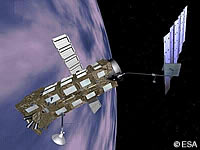
Envisat, the largest and most sophisticated Earth observation satellite ever built in Europe, was successfully launched in the early hours of 1 March with Europe's Ariane 5 launcher in French Guyana. Envisat or 'Europe's environmental eye', as the European space agency (ESA) has dubbed it, will deliver an unprecedented wealth of images and data from an altitude of 800 kilometres, helping scientists better understand the Earth. 'This has been a particularly exciting day for ESA and the European space community as a whole,' said José Achache, ESA's Director of Earth observation. 'Europe is taking an important lead in global observations for worldwide environmental needs and Envisat is going to make a significant impact on the future remote sensing of the Earth.' EU Research Commissioner Philippe Busquin, who is also responsible for space policy, welcomed the news of a successful launch. 'I congratulate ESA, CNES, Arianespace and all European scientists involved, on the successful launch of Envisat,' he said. 'Europe's environment satellite is a good illustration of Europe's first class space science and technologies. [...]. More accurate and reliable information will help Europe better address problems such as global change, natural catastrophes or mass movements of refugees. Envisat is set to become a cornerstone in our policy of building an autonomous European capacity for global monitoring which the European Commission and the European space agency are jointly piloting,' he said. Data from Envisat's 10 scientific instruments will build the most detailed profile ever constructed of the planet's atmosphere, land, rivers and seas. In addition to monitoring movements of the Earth's surface, glaciers, ice caps and oceanic currents, Envisat will also help to optimise maritime traffic, monitor land use and respond to natural disasters such as volcanic eruptions, earthquakes, floods and forest fires. Envisat will also foster a whole new generation of innovative, user-driven space applications and services for the environment and security. Practical applications of space technologies and the development of space based services are key priorities of the Commission's Framework programmes, which include the exploitation of space data and their integration into long term, systematic observations systems for the environment and sustainable development. The satellite took 14 years to construct, cost 2.3 billion euro and involved a number of European research institutions. Envisat is expected to be declared operational in a few weeks, once the various data recovery links have been set up. Data produced by Envisat will be processed by 16 ongoing EU research projects, which cover many areas, from ozone depletion, greenhouse gases, glaciers, oceans and coastal zones, to assessing forest and land use and understanding the carbon cycle. The Commission began to support space observation for environmental monitoring and research in 1994. Since then, around 150 related projects have received EU funding amounting to 150 million euro. The goal is to foster European capability in operational services and applications for monitoring the Earth from space.