


UK Joint Research Councils announce winner of business plan competition
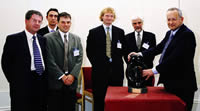
The UK's Joint Research Councils announced the winner of a competition to find the best business plan to commercialise British funded science on 8 May. The judging took place at the Royal Society with a top prize of 25,000 GBP (around 40,000 euro) awarded by science and innovation minister Lord Sainsbury. The overall winner was Nottingham University's Critical Pharmaceuticals Ltd. The team has developed a new method of delivering stem cell treatments, which contain fragile molecules and cells whose disease-curing properties can easily be destroyed, whilst protecting both the drugs and the cells. The four runners up include the University of Newcastle's Hale-Stephenson, whose researchers have developed a new impact and vibration sensor that can be sprayed on to the surface of any structure like paint. Their 'smart' paint has already been tested on the Gateshead Millennium Bridge over the River Tyne. NanoCo Technologies Ltd, from the University of Manchester, will manufacture and supply customised 'Quantum dots,' tiny particles of semiconductor material that will form the basis of new technologies in areas such as banknote security-tagging. Southside Thermal Sciences from Imperial College, London, have developed a 'smart' ceramic coating for use in gas turbines, such as those in jet engines, that will allow maintenance engineers to monitor wear and tear on turbine blades without having to shut them down. At present, turbine blades are protected from extreme temperatures and weathering by a standard Thermal Barrier Coating which can fail after a period of continuous wear or through crumbling and flaking. The team Shibden Technologies, from the University of Warwick, has produced a novel method for producing audible sound by using high frequency sound signals. The new technology will allow mobile phones, laptop computers and hi-fi systems to produce good quality sound in a small space. The efficiency of loudspeakers can also be improved, as the new method uses less than 5 per cent of conventional audio power. The Joint Research Councils business plan competition involves the UK's Economic and Social Research Council, the Engineering and Particle Physics Research Council, the Natural Environment Research Council and the Particle Physics and Astronomy Research Council.