


Earth radiation instrument provides first measurements
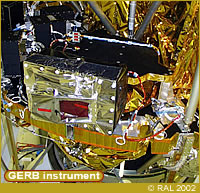
The GERB instrument (Geostationary Earth Radiation Budget), set up by the European Space Agency (ESA) and flown on board EUMESTAT's MSG-1 geostationary satellite, has provided its first measurements. The measurements, received on 12 December, enabled scientists to determine, through images, the net gain and loss of energy in the climate of the whole hemisphere. With the results of such measurements, the Earth's climate system can be monitored more closely: The GERB instrument is a radiometer that scans the Earth using two broadband channels: one, which monitors the global amount of radiation emitted, the other which scans short wavebands, By calculating the difference between both these channels, an approximate estimate can be made of the energy that radiates from the Earth and in turn, the energy that is the driving force behind the Earth's climate system. GERB, along with SERVIRI, the main imager on MSG-1, will help scientists research and determine whether clouds or water vapour influence the radiation balance and have any direct consequence on climate models. Eva Oriol-Pibernat, MSG Mission Manager at ESA emphasised the impact that the GERB instrument will have on European monitoring of the climate and environment. 'GERB will enable us to follow trends in key climate parameters from a fixed point in orbit. Combining these results with data gathered by ESA's Envisat and ERS-2 satellites, Europe will thus be able to contribute significantly to the monitoring of climate and the environment.' The GERB instrument, funded by a European consortium from the UK, Belgium and Italy, has also received scientific support from a team made up of international members, at the head of which is Professor J. Harries from Imperial College, London, UK. The instruments will accompany future meteorological satellites, notably, the MSG-2 and MSG-3. These satellites are part of the MSG programme, which is ESA/EUMETSAT joint programme. EUMESTAT's MSG-1 geostationary satellite was developed by ESA, which coordinates the procurement of other satellites and is currently discussing the procurement of the fourth satellite in the same family. EUMETSAT is responsible for outlining user requirements as well as all launches, system operations and the ground segment development.