


Prodi initiates industrial policy review with enlargement in mind
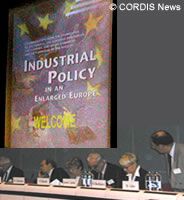
Commission President Romano Prodi has warned European politicians and business leaders not to stand in the way of the industrial changes that enlargement will bring, but to respond to them through a review of policy. Opening a conference on industrial policy in an enlarged Europe in Brussels on 21 January, Mr Prodi said that the movement of workers and relocation of businesses would be an inevitable consequence of the accession process. 'Industry must get ready to tap the huge number of scientists, technicians and skilled workers who will soon be joining us as new citizens. They offer a great opportunity for growth and development,' Mr Prodi told participants. The President also had a message for the national government ministers present at the event, saying that Member States needed to do more to increase investment in research. A rise in research spending, he said, 'is the only way to keep our most promising young people and attract researchers and scholars from abroad.' During a panel discussion on the framework conditions of Europe's industrial policy, the Commissioner for Enterprise and the Information Society, Erkki Liikanen, supported the review of European industrial legislation. He argued that following the introduction of the euro, the extension of the internal market, the growth of new technologies and the enlargement process, the time had come to revisit and rethink EU policy in this area. The UK Minister for Trade and Industry, Patricia Hewitt, contributed to the discussion by highlighting the key themes that she felt should guide Europe's future industry policies. These include the promotion of entrepreneurship, with an emphasis on the contribution of small and medium-sized enterprises (SMEs), the creation of a European patent, skills development for all citizens, and the deployment of all available resources to support innovation and technological progress. Ms Hewitt went on to assert that, in the context of emerging global economies such as China, Europe could no longer remain competitive on the basis of low costs and wages. Industry, she said, 'needs to focus on the high end of the market in sectors where the EU can compete', and warned that such a shift would not only apply to traditional industries such as textiles, but to newer service-based industries as well. Ms Hewitt also supported comments made earlier by the Greek Minister for Development, Akis Tsohatzopoulos, concerning the role of the EU's Competitiveness Council as a driver of industrial policy. Mr Tsohatzopoulos, who is also the current chairman of the Competitiveness Council, said: 'The Competitiveness Council will give an impetus to European industrial policy and ensure that it is coherently applied. [...] The Council helps all sectoral areas to work hand in hand.' He highlighted the need for cross-cutting industrial policies which take account of the impact on competitiveness of other policy areas, such as education, research, transport, SMEs and micro organisations, and development. Representing European business, Georges Jacobs, President of the union of industrial and employers' confederations of Europe (UNICE) focussed his comments on the research spending target of three per cent of GDP. 'It is very important to have a target, but I don't know whether it is a realistic one,' he said. Mr Jacobs said that before businesses could work towards achieving the objective set in Barcelona, he would like to see action being taken to create a more favourable legislative environment for research investment, including agreement on a European patent, the removal of barriers to technology transfer, and the introduction of financial or fiscal instruments to encourage research investment. The conference was organised to initiate a broad public debate on Europe's industrial policy, and in his closing remarks, Mr Prodi spoke of the debate's importance in the wider context of sustainability. The creation of a dynamic industrial policy, he said, will create the conditions for a strong economy, and is, therefore, 'yet another way of achieving a proper balance between the economic, social and environmental pillars' of sustainable development.