


Hubble reveals first evaporating extrasolar planet
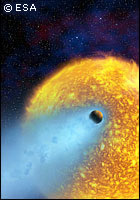
Using the Hubble space telescope, a team of European astronomers has observed, for the first time, the evaporation of a planet. The evaporation was caused by the planet orbiting very closely to its parent star. Discovered in 1999, the HD 209458b extrasolar planet is one of a hundred detected planets that orbit stars other than the Sun and which are commonly referred to as 'hot Jupiters'. It is believed that 15 per cent of these planets orbit their parent star too closely. It takes HD 209458b only three and half days to orbit its parent star, with a distance of only seven million kilometres between the two. In contrast, Jupiter is the closest gas giant in our solar system that travels around the Sun but has a distance of 780 million kilometres separating it from the Sun. Due to its proximity, astronomers believe that the mass of hydrogen, which envelops the planet, is gradually being boiled off. 'The atmosphere is heated, the hydrogen escapes the planet's gravitational pull and is pushed away by the starlight, fanning out in a large tail behind the planet - like that of a comet,' says Alain Lecavelier des Etangs of the astrophysical institute in Paris. Scientists estimate that some 10,000 tonnes of hydrogen per second are being lost from the planet. 'We were astonished to see that the hydrogen atmosphere of this planet extends over 200,000 kilometres,' says Alfred Vidal Madjar of the French national research centre (CNRS) and coordinator of the team. This may explain why no extrasolar planets can be found within a seven million kilometre radius of their star. As a result, scientists predict that the planet may eventually disappear, leaving only a dense core. Studying extrasolar planets proves difficult due to the blinding light emanating from their parent stars. Scientists were able to able to observe the HD 209458b planet during a three hour eclipse. The European Space Agency (ESA) will continue its study of these 'hot Jupiters' with several scientific missions, including the Eddington mission, which is to be launched in 2007.