


Research DG national experts provide a 'window' to the candidate countries
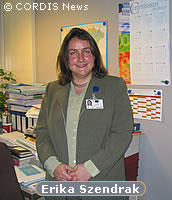
As the referendum in Hungary on 12 April demonstrated, Hungarians are enthusiastic about their integration into the EU. This attitude is supported by statistics showing the number of employees in the European Commission's Research DG representing the candidate countries. The first DG to take on staff from the candidate countries, the Research DG currently has 13 national experts from the candidate countries, five of whom come from Hungary. Erika Szendrak is one such Commission expert. She was one of the first stagiaires from a non-Member State to arrive in Brussels in 2000, and then returned as a seconded national expert in 2002. She is currently following up national research policies in the candidate countries and is involved in the Research DG's benchmarking exercise led by the 'open coordination of research policies' unit. With the candidate countries now able to participate on an equal footing with the EU Member States under the Sixth Framework Programme, enlargement has already occurred in the field of research. Dr Szendrak's path to Brussels was one of 'a touch of international mobility, a touch of enlargement issues, a touch of using skills that I never thought I'd use at such a level when I was doing my PhD studies,' she said in an interview with CORDIS News. Having studied horticulture and biotechnology in Hungary, Dr Szendrak spent almost four years in the United States lecturing and working on a PhD. After finishing her post doctoral studies, she returned to Hungary. Her return in 1998 coincided with Hungary's accession to the Fifth Framework Programme (FP5) and the accompanying thirst for information on how to participate. She took up a position with the Hungarian Science and Technology Foundation assisting Hungarian researchers to participate. A five month 'stage' in the Research DG's 'preserving the ecosystem - coordination of horizontal aspects' unit followed, which Dr Szendrak knows from former colleagues was 'beneficial for both sides'. While she was able to expand her knowledge of FP5, the Commission benefited from her understanding of research within the candidate countries. The opportunity to work as a seconded expert arose in 2002, and Dr Szendrak believes she was selected because of her knowledge of the candidate countries and because she had experience in working with these researchers and their support organisations. Again, both sides benefit from the appointment. Dr Szendrak believes that she acts as a 'window' for both the Commission and the candidate countries, providing one with information about and from the other. She is able to introduce the Commission to how researchers are networking in the candidate countries, provide information about the research culture and show her colleagues where they should look for additional information. The candidate countries, on the other hand, gain from Dr Szendrak's knowledge of how to deal with EU matters and her guidance on bureaucratic traditions, 'which are sometimes very complex and sometimes not so complex.' And again, she is able to point people in the right direction when they have a query. Georges Papageorgiou, head of the DG's personnel unit told CORDIS News that while the Commission has no plans to take on people from the candidate countries on a large scale until after enlargement, citizens of these countries will have the opportunity to work in auxiliary positions before then. With enlargement already having taken place within DG Research's programmes, the DG is likely to utilise this possibility. But are those in the candidate countries who could be eligible for such a position aware of the opportunities open to them in Brussels? 'There is a lot of information and a lot of opportunities here, but if you're not accustomed to where to look and who to ask, then you lose,' said Dr Szendrak. 'People are accustomed to information arriving without asking for it. This is not the case. You have to look for it, you have to do your homework, you have to have your well-formulated questions. If you do, you will get answers,' she added. For this reason, there are currently huge information campaigns in the candidate countries, coordinated jointly by the national authorities and the Commission. Asked how she feels to be one of the first people from a candidate country to have a position within the Commission, Dr Szendrak expressed her pride and sense of responsibility: 'Of course I'm very proud [...] and I very much appreciate this possibility. But I also feel responsibility with that. [...] In a certain way I feel I'm representing my country. And I think all of us who are here from the candidate countries know very well that when people meet us, they not only see us as a person, but also see 'this is somebody from a certain country.' She describes her current position as a 'challenge', but one which she is very much enjoying and benefiting from, 'both professionally and in a human and personal way.' And why is Hungary so well represented within the Commission? 'Hungarians have always been very international, very open to the world and networking people. There may also be historical reasons and geographically we are in the middle of Europe,' suggests Dr Szendrak.
Countries
Bulgaria, Cyprus, Czechia, Estonia, Hungary, Lithuania, Latvia, Malta, Poland, Romania, Slovenia, Slovakia, Türkiye