


JRC Director-General tells CORDIS News of his role as 'repairer and developer', which is now coming to an end
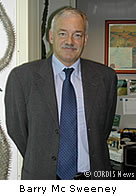
Having made enlargement a priority on his appointment as Director-General of the Commission's Joint Research Centre (JRC), it is appropriate that Barry Mc Sweeney is now helping to select his replacement, who the Commission has decided must come from one of the EU's new Member States. When Dr Mc Sweeney arrived in 2001, the climate within the JRC was rather uncertain. 'People used to ask me 'which part will you be closing first?', he said in an interview with CORDIS News. 'Those days are well gone,' he added. The JRC is described by Dr Mc Sweeney as a 'research based policy support body'. It supports the Commission's DGs, as well as European Parliament committees and the Member States, when it is asked to do so. Some 30 per cent of EU legislation has a very defined technical requirement, and to help draw up legislation that is technically sound and workable, the JRC steps in and conducts the necessary research and provides technical assistance. Recent 'hot areas', as Dr Mc Sweeney calls them, for which the JRC has provided policy support include legislation on genetically modified organisms (GMOs) and the REACH chemicals directive. On a more global level, the JRC recently provided enhanced satellite imagery of Israel's West Bank barrier and escape routes out of Iraq. His mission, Dr Mc Sweeney told CORDIS News, is to decrease the use of the precautionary principle, on which the majority of EU legislation is based. 'Evidence-based science will make it less necessary,' he says. Despite the importance of the advice that the JRC provides, the organisation has remained largely invisible to the general public. Asked whether he would like to raise the profile of the JRC in order to receive recognition for this important work, Dr Mc Sweeney replied that it is more important to him to raise awareness among policy makers than the public at large. 'In PR [public relations] terms, the amount of expenditure that would be necessary in order to raise the profile of the JRC among the general public is so high that it is not justifiable,' he said. 'What we are working on is getting our role better understood by policy makers.' And there has been success in this area. Member States are now seeking further cooperation with the JRC, according to Dr Mc Sweeney. The JRC is particularly well known by the EU's acceding and candidate countries, not only because of its specific 'Enlargement Action', but because of the help it has provided during emergency situations, such as the floods which devastated parts of the Czech Republic and Hungary in the summer of 2002. High resolution satellite images were able to provide information on water movement and support those working on the ground. Since then, the JRC has developed the only map of every land cover area in the world, as well as a European flood alert system. The JRC also provided information to those tackling the forest fires in France, Portugal and Spain during the summer of 2003, and was the first to warn that the Prestige tanker, which sunk off the coast of Spain, was leaking oil. Upon his appointment as Director-General, Dr Mc Sweeney's first decision was to make enlargement a priority, he says. The JRC has therefore assisted the candidate and acceding countries in a number of additional ways - by providing training on EU legislation, for instance. Some 1,100 researchers from the enlargement countries received such training in 2003. The organisation has now started a new form of training, 'multiple visit fellowships', which allow researchers from these countries to avoid the disruption of a three year period abroad by encouraging them to spend several three-month periods at the JRC and the intervening periods at home. The JRC's Enlargement Action, described by Dr Mc Sweeney as 'so simple it was very good', will not change following enlargement in May, but is likely to adapt to a new role. 'I am sure the new Member States will ask us to do a lot of work with them, as we have done a lot in the past. We will first focus on getting them involved in networks.' Asked whether there are specific areas in which the new Member States may require particular assistance from the JRC, Dr Mc Sweeney pointed to areas that require access to sophisticated equipment and consequently substantial financial investment. Dr Mc Sweeney's work is certainly appreciated by one acceding country, Slovakia, which is to award him the Grand Gold Medal of Comenius University. The award recognises Dr Mc Sweeney's 'strong commitment to making the JRC's support to enlargement a key policy and thus contributing significantly to opening the European Research Area to Slovakia and other accession and candidate countries.' Criticisms of the JRC were addressed in, for example, closing the space applications institution - 'I'm not interested in technologies per se, I want to support policies'. Projects were streamlined into priorities and those considered obsolete were terminated. 'The JRC is now at a structural stage that can sustain change for a number of years. But I will make no more changes.' Today's JRC, the only multidisciplinary pan-European research organisation, has institutes in Belgium, the Netherlands, Germany, Spain and Italy. Having contributed to the enlargement process and implemented the streamlining of the JRC, Dr Mc Sweeney feels that his work as 'repairer and developer' is nearly done, and that he will soon be ready to move on. His successor, as yet unknown, will inherit a highly respected and valuable organisation.
Countries
Bulgaria, Cyprus, Czechia, Estonia, Hungary, Lithuania, Latvia, Malta, Poland, Romania, Slovenia, Slovakia, Türkiye