


Dutch astronaut's space station visit is a voyage of scientific discovery
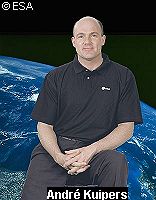
European Space Agency (ESA) astronaut André Kuipers, from the Netherlands, was part of the three-man ISS Expedition 9 crew that lifted off from the Baikonur Cosmodrome in Kazakhstan on 19 April, bound for the International Space Station. The Russian-built Soyuz TMA-4 spacecraft was also carrying NASA astronaut Edward Fincke and Russian cosmonaut Gennady Padalka. The three men replace the previous ISS crew, which arrived in October 2003 and included Spanish ESA astronaut Pedro Duque. Dr Kuipers becomes the seventh European astronaut to visit the ISS and the first from the Netherlands. He will only spend nine days aboard the space station before returning to Earth with the current ISS crew, but during that time he plans to carry out 15 scientific experiments developed for ESA's DELTA mission. The experiments cover the areas of human physiology, biology, microbiology, physical science, Earth observation, technology demonstrations and education. Many of the experiments were developed by Dutch researchers and built by Dutch industry and research institutions. One of the experiments under the human physiology heading will test the hypothesis that the atrophy, or weakening, of certain deep abdominal muscles in weightlessness, leads to lower back pain in astronauts. Dr Kuipers will fill in a questionnaire which records specific information including the location of any lower back pain, it's acuteness and it's length of duration. The results will then be compared with similar studies carried out on Earth. Biological experiments will include the first physiological and genomic study of a nematode worm in space. This will include an analysis of almost the complete genome of the nematode worm in weightlessness to see which genes react differently in space than on Earth. Dr Kuipers and colleagues will also study the development of nematode worm larvae in space. Under the technology heading, Dr Kuipers will test a vibrating vest designed to help astronauts with orientation in space. The vest consists of numerous small vibrating elements covering the torso that inform the astronaut of a predefined direction within the ISS by vibrating in that direction. The designers hope that the vest will prove to be an intuitive method of orienting astronauts, and will improve safety, performance and comfort. Jörg Feustel-Büechl, ESA's director of human spaceflight, said: 'It is always satisfying to see a mission underway after observing all the hard work that has gone into its preparation. The DELTA mission is a very diverse programme, with relevance to the lives of people both old and young.'
Countries
Netherlands