


Mass market for hydrogen transport by 2020, industry figures predict
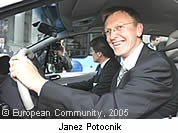
On the eve of the second general assembly of the European hydrogen and fuel cell technology platform (HFP) in Brussels on 16 March, industry representatives presented the latest innovations in hydrogen powered transportation to decision makers at a 'ride & drive' exhibition. One person obviously enjoying the 'riding & driving' was EU Science and Research Commissioner Janez Potocnik, who test drove one of the latest hydrogen road vehicles in the shadow of Brussels' Cinquantenaire Arch, before taking a turn around the conference exhibition in Autoworld in a hydrogen powered wheelchair. When asked by journalists how he had found the experience, a beaming Mr Potocnik said: 'I knew that hydrogen technology has advanced rapidly in recent years, but I was really surprised to see a hydrogen fuel cell car at such an advanced stage of development.' On what felt like the first evening of spring in Brussels, the CEO of Shell Hydrogen and chair of the HFP, Jeremy Bentham, told the audience that they were also witnessing 'the springtime of the hydrogen industry!' He agreed with the Commissioner on the astonishingly rapid progress made by the industry, adding: 'Only one thing is certain: that nothing remains static in the world of hydrogen and fuel cells.' Despite the genuinely impressive hydrogen vehicles and other technologies on display, Mr Bentham was however quick to sound a note of caution: 'We are also realists,' he said. 'Important advances in the technology are still needed, as well as an effort to integrate these separate advances [into viable products and markets].' Mr Bentham also warned that it is clear the US and Japan have now woken up to the potential of hydrogen, and are pressing ahead with their own initiatives. 'I believe there is still a danger that the EU can fall behind its competitors in the race to market if we don't keep up our efforts. We have 25 countries to organise, while Japan and the US have just one [...] and we must not allow our activities to become fragmented.' Nevertheless, Mr Bentham predicted that early markets for hydrogen products such as portable power generators could realistically be established by 2007 to 2010, with mass markets for hydrogen transport becoming a reality before 2020. 'However, if the EU's next move is to try to place a handful of hydrogen vehicles in all countries, we will fail,' he cautioned. Rather, Mr Bentham would like to see companies cooperating to establish lighthouse projects to 'bridge the gap between research and reality'. 'We must scale up our manufacturing capability and demonstrate facilities on a scale that will actually mean something to the public,' he told colleagues from industry. Meanwhile Herbert Kohler, chief environment officer for DaimlerChrysler, emphasised the ecological benefits of switching to hydrogen-powered modes of transport. Road transportation using fuel cells and hydrogen derived from natural gas would cut carbon dioxide emissions by 40 per cent compared with a system based on diesel, he said. 'Our main message to decision makers must be that hydrogen and fuel cells - based on renewable energy sources - is the only currently conceivable zero emissions drive system.' Mr Kohler highlighted the research challenges that still lie ahead: 'Further R&D is necessary to improve the lifetime of products, reduce costs and increase technical maturity. Long term and stable funding will be needed in order to achieve that.' Mr Potocnik certainly gave the technology platform the full backing of the Commission: 'I'm happy that through the hydrogen and fuel cell technology platform - one of the pioneers of the concept - you have found the right way to address this global challenge. It is also a good example of what we will be trying to achieve under [the Seventh Framework Programme] - future research challenges being addressed through technology initiatives. Thank you for your good work, and good luck,' he concluded.