


Europe to return to Mars
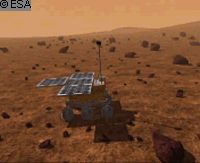
A detailed proposal for a European mission to Mars is to be prepared after a recommendation from European scientists to send a rover to the Red Planet as part of the European Space Agency (ESA) Aurora programme of planetary exploration. The aim of the mission would be to conduct a detailed analysis of the Martian environment, and to search for traces of past or present life. The launch is foreseen for June 2011, which would see the rover arriving on Mars two years later in June 2013. The recommendation was made at an international space workshop in Birmingham on 7 April. Three candidate missions were considered: BeagleNet, ExoMars and ExoMars-Lite. Following presentations of each proposal, scientists carried out an evaluation using criteria such as the scientific merit of the proposal, scientific excellence versus cost, the length of time necessary to prepare for each mission, and the importance of the mission's technology to a long-term European and international programme of planetary exploration. The evaluators saw merits to each of the candidates, and recommended that the mission should blend key technologies and objectives from each. This recommendation will form the basis of the detailed proposal to be submitted to the ESA council meeting at ministerial level, which will take place in December. The scientists present in Birmingham recommended a mission consisting of a Soyuz launcher, and a probe that includes at least one rover for scientific exploration of the Martian environment. Communication between the probe and Earth will be achieved via a NASA orbiting spacecraft. The rover would be equipped with a plethora of scientific instruments that would not only search for traces of past or present life, but also characterise the shallow subsurface water and its vertical distribution profile, and identify surface and environmental factors that could pose a risk to future human missions. The rover would also carry a drill capable of boring two metres into the Martian surface, and a Beagle 2 type 'life marker experiment' such as a gas analysis package that could study stable isotopes in the atmosphere, rocks and soil. Building on data collected by ESA's Mars Express orbiter, the recommended mission would incorporate instruments to measure seismic phenomena that could be caused by volcanoes, hydrothermal activity or Marsquakes.