


Project to develop traps and repellents for malarial mosquitoes
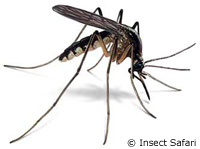
An international team of scientists will cooperate for the next five years in a research project aimed at developing odour traps and effective repellents to keep malarial mosquitoes away from potential human hosts. Developing new ways of preventing insects from transmitting malaria might reduce substantially the risk of transferring a disease that already affects between 300 and 660 million people worldwide. Malaria is the most important life-threatening disease in the world, causing more than a million fatal victims per year. A team of scientists from Vanderbilt University and Yale University in the US, and Wageningen University in the Netherlands, will cooperate with researchers from the Ifakara Health Research and Development Centre in Tanzania and the Medical Research Council Laboratories in Gambia (Africa) in this 7 million euro project funded by the Grand Challenges in Global Health initiative of the Bill and Melinda Gates Foundation. Malaria is caused by Plasmodium spp, a parasitic protozoa that infects human red blood cells. Malaria parasites have a complex life cycle: in order to live, these parasites need to have both a human host and a female mosquito host of the genus Anopheles. The mosquito picks up the malaria parasites from the blood of an infected human when it feeds, and the parasite then reproduces itself in the gut of the Anopheles mosquito, hence why malaria parasites also need mosquitoes to continue their life cycle. The mosquito can then pass further malaria parasites to humans through its salivary glands. To find a proper host, female malarial mosquitoes are guided by the odours they intercept with their antennas. Once they recognise the host's odour, they suck up the blood they need for egg production. As it draws blood, parasites from the mosquito enter the human body. When an infected person - after an incubation period of ten to fourteen days - is bitten again by another mosquito, the malaria parasite is transmitted to that mosquito and therefore spread more widely throughout the mosquito population. The malarial mosquito targets a complex mix of odours to find a host. The US partners in the research team will develop odours for which the mosquito antennas are very sensitive. This team will identify and test either attractive or repellent odour materials or materials causing confusion. After that, the Wageningen University team will look at the effect of the selected odour materials on mosquito behaviour. The substances provoking the strongest reaction (either by attracting, repelling or causing confusion) will then be tested in a simulated natural situation in Ifakara, Tanzania. The best blend of odours will be taken to African villages for full-scale practical tests as part of the project. The villages, located in Gambia and Tanzania, are situated in different geographical extremes with different mosquito populations, and the results of the research project should therefore be applicable for much of tropical Africa. If the project is successful, African households will have an added degree of protection provided by strong new repellents or odorants that confuse the mosquito's sense of smell, causing less mosquito biting, while outside the villages, insect traps with attractive odorants could be used as bait. Moreover, the final results of the project could be tested against other pathogenic mosquitoes, such as the mosquito Aedes aegypti, which spreads dengue fever, and Culex pipiens, carrier of the West-Nile virus.
Countries
Netherlands, United States