


Commit substantial share of Structural Funds to research and innovation, says Hübner
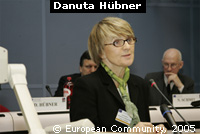
The Commissioner for Regional Policy, Danuta Hübner, has called on the EU's Member States and regions to dedicate 'a substantial share of their Structural Fund [...] resources to research and innovation in future.' Addressing a conference in Slovakia on the Structural Funds and support for research and development, Ms Hübner described research and development (R&D) as tools for creating lasting change in the economies of disadvantaged regions of Europe, and revealed that between 2000 and 2006, close to ten billion euro of Structural Funds will have been spent on research, development and innovation. 'We are resolved that we need to progress further in the next programming period,' said the Commissioner. 'If we are genuine about achieving the Lisbon goals and realising the potential of all Europe's regions, we need to move beyond a situation where 25 per cent of R&D investments are made in just eight regions. The Structural Funds offer the chance to do this.' Whilst curiosity-driven research is important for generating long-term economic benefits, Ms Hübner stressed that the Structural Funds need to improve regions' economic performance in the short to medium term. 'So I encourage you to look at R&D in the context of innovation and focus the Structural Funds on those R&D investments which will pay real economic dividends.' This will require regional and national policy makers to decide exactly how they will use the Structural Funds to encourage future research and innovation activity, said the Commissioner, calling on them to draw up strategies that enable their public and private sector research players to take full advantage of the opportunities available to them. 'You can learn from the experience of other Member States,' said Ms Hübner, 'and the EU has supported the development of a wealth of tools [...] all of which you can draw on to inform your future strategy for research and innovation. Your objective must be to have strategies adapted to the situation in each region, corresponding to its economic development needs and potential, especially the needs of its small and medium-sized businesses.' The Commissioner then placed financial support for research and innovation in its wider strategic context, describing it as just one element in the process of knowledge-production leading to commercial results. Support is also needed to develop the right mix of skills within regions, and adequate business support services are also needed to create practical links between research and industry. 'It is essential to connect public authorities, large and small businesses and universities and research institutes and to form regional networks between them,' argued the Commissioner. '[E]xperience shows us that research needs a critical mass of people exchanging ideas - and sharing sometimes expensive facilities. [...] So clusters are essential.' Ms Hübner emphasised the need for a swift resolution to the EU budget negotiations so that the new Structural Fund programmes are ready to implement from 1 January 2007. She realises that in the 'tense context ' of budget negotiations there is a tendency in some quarters to characterise the Structural Funds as a 'mere income redistribution mechanism', but countered that 'nothing could be further from the truth'. The Structural Funds are not 'dependency-perpetuating subsidies', concluded the Commissioner. 'They are ways of transforming a region's economy in a lasting way, enabling it to realise its potential and benefit both its own citizens and the EU as a whole [...] and I exhort you to take full advantage of the unique opportunities which they offer.'